Historical Significance
Founder of the Tudor dynasty who transformed England from a war-torn kingdom into a stable, prosperous nation.
Biography
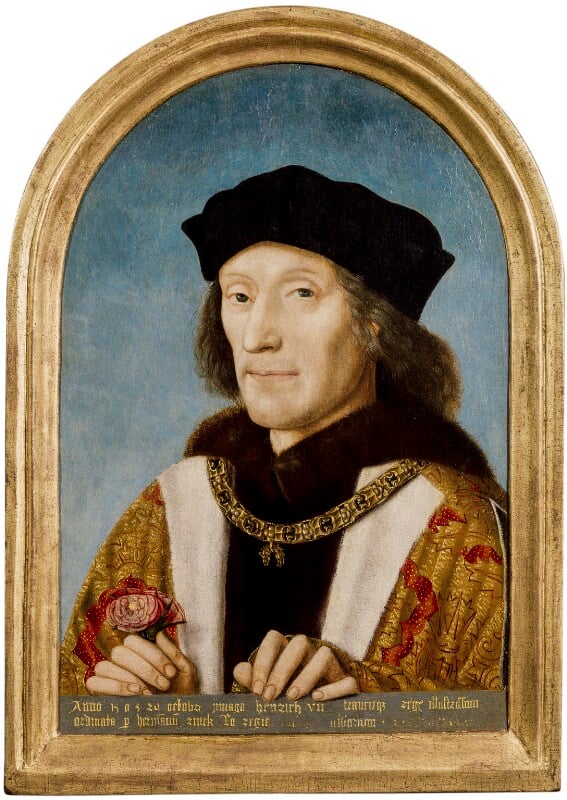
Henry Tudor was born on 28 January 1457 at Pembroke Castle, Wales, the son of Edmund Tudor, Earl of Richmond, and Lady Margaret Beaufort. His claim to the throne came through his mother, a descendant of John of Gaunt, Duke of Lancaster.
After spending much of his youth in exile in Brittany and France during the Wars of the Roses, Henry returned to England in 1485 with a small army. On 22 August 1485, he defeated King Richard III at the Battle of Bosworth Field, claiming the crown by right of conquest.
To strengthen his claim and unite the warring factions, Henry married Elizabeth of York, daughter of Edward IV, in 1486. This union combined the houses of Lancaster and York, symbolized by the Tudor rose—a combination of the red rose of Lancaster and the white rose of York.
Henry VII proved to be a shrewd and capable ruler. He restored stability to England after decades of civil war, rebuilt the royal treasury through careful financial management, and established diplomatic ties across Europe through strategic marriages for his children.
His reign saw the beginning of England's transformation from a medieval kingdom into a modern nation-state. He died on 21 April 1509 at Richmond Palace, leaving a secure throne and a full treasury to his son, Henry VIII.
Key Facts
Won the crown by conquest at the Battle of Bosworth Field
Married Elizabeth of York, uniting the houses of Lancaster and York
Accumulated a fortune of £1.5 million (equivalent to billions today)
Established the Court of Star Chamber to enforce law
Father of Henry VIII and grandfather of Elizabeth I
Spent 14 years in exile before claiming the throne
Built the magnificent Henry VII Lady Chapel at Westminster Abbey