Whitehall Palace: The Lost Heart of Tudor Power

Imagine a palace so vast, so sprawling, that it defined the very landscape of London. This was Whitehall, not merely a residence, but the monumental, pulsating heart of the Tudor monarchy, particularly under the reign of the formidable Henry VIII. From its opulent galleries to its bustling courtyards, Whitehall was the stage upon which England’s most dramatic political and personal narratives unfolded. Before Henry VIII, it was known as York Place, the grand London residence of the powerful Cardinal Thomas Wolsey. When Wolsey fell from grace in 1529, Henry seized the property, transforming it into the largest palace in Europe, a testament to his absolute authority and insatiable desire for grandeur. Whitehall became synonymous with Tudor majesty, a place where policy was forged, treaties were signed, and the fate of queens was decided.
From York Place to Royal Seat: Henry VIII’s Grand Vision
The acquisition of York Place marked a pivotal moment in English history. Henry VIII, having cast off his chief minister, immediately set about erasing the memory of Wolsey while simultaneously leveraging the Cardinal's immense architectural achievements. Wolsey had spared no expense, creating a magnificent complex that dwarfed the nearby Palace of Westminster. Henry, however, was determined to outshine his former servant. He renamed it Whitehall (likely after the white stone used in some of its construction or simply the ‘white hall’ within the complex) and embarked on decades of expansion and embellishment.
The scale of Whitehall was staggering. It stretched over 23 acres, encompassing grounds that ran from the Thames nearly to modern-day St. James’s Park. Unlike a single cohesive building, it was a complex labyrinth of over 1,500 rooms, connected by galleries, courtyards, and gardens. It was a small city dedicated to the Crown, housing not only the royal family but also the entire machinery of government, including the Privy Council, the Chamber, and hundreds of household staff.
The Splendour of the Privy Gallery and the Holbein Gate
Two features epitomised the palace's magnificence during the Tudor era: the Privy Gallery and the Holbein Gate. The Privy Gallery was the central artery of the court, a long, richly decorated space where courtiers waited, whispered, and sought access to the monarch. It was here that power brokers met and where Henry VIII often displayed his latest acquisitions, including his impressive collection of armour and tapestries.
The Holbein Gate, built around 1532, was a masterpiece of Renaissance architecture, though its attribution to Hans Holbein the Younger is debated. This ornate, turreted gateway spanned the road, connecting the main palace complex to the tilt yard and the royal apartments. It served as a symbolic barrier between the public sphere and the private world of the King.
Did You Know?
When Henry VIII married Anne Boleyn in 1533, the secret ceremony is believed to have taken place in a small, private chapel within Whitehall Palace, signifying the palace's role in the seismic shifts of the English Reformation.
The Courtly Life: Pageantry, Politics, and Pleasure
Life at Whitehall was a relentless cycle of ceremony and entertainment. The palace was designed to project power and legitimacy, and the Tudors, masters of propaganda, used its spaces expertly. Henry VIII, especially in his younger years, hosted legendary tournaments in the Tiltyard, a vast area located across the street from the main palace, accessed via the Holbein Gate.
The Great Hall was the scene of lavish banquets and masques. These elaborate theatrical productions were not mere entertainment; they were political statements, often celebrating royal births, marriages, or military victories. It was in the Great Hall that Henry VIII first publicly danced with Anne Boleyn, a bold declaration that scandalised Europe.
“The King’s Majesty hath here a house that is not only a palace, but a city, and such a city as may be called the heart of the realm, for all matters of consequence are here determined.” – A contemporary observer, reflecting on Whitehall’s importance.
Under Henry’s children, Edward VI, Mary I, and Elizabeth I, Whitehall remained the principal seat of government. Edward VI died there in 1553. Mary I married Philip II of Spain by proxy within its walls, and Elizabeth I used its complex layout to control access and maintain her mystique. The Privy Chamber, a highly restricted space, was where Elizabeth conducted her most sensitive political negotiations, mastering the art of controlled visibility.
- The Cockpit: Originally built for cockfighting, it was later converted into a private theatre for royal performances.
- The Tennis Courts: Henry VIII was an avid player of Real Tennis, and Whitehall boasted several courts.
- The Banqueting House: Though the famous structure standing today is Stuart, the Tudors had several temporary and permanent banqueting houses used for grand feasts.
- The Gardens: Extensive privy gardens provided private retreats for the monarchs, filled with exotic plants and elaborate fountains.
The Artistic Legacy: Holbein and the Tudor Image
Whitehall was a centre for Renaissance art, largely due to Henry VIII’s patronage. The King employed some of the finest artists in Europe, most notably Hans Holbein the Younger, who served as the King’s Painter. Holbein’s studio was located within the palace complex, and his work was crucial in shaping the visual identity of the Tudor dynasty.
It was at Whitehall that Holbein painted his famous portraits of Henry VIII, Anne of Cleves, and numerous courtiers. Most significantly, Holbein created the monumental mural depicting the Tudor dynasty in the Privy Chamber, featuring Henry VIII, Jane Seymour, and his parents, Henry VII and Elizabeth of York. Though the mural was tragically destroyed in the 1698 fire, copies and sketches survive, demonstrating Henry’s imposing, powerful image—an image carefully crafted within the walls of Whitehall.
The Fall of Queens and the Rise of the Reformation
Whitehall was the silent witness to Henry VIII’s marital turmoil. The palace saw the arrival of five of his six wives. Anne Boleyn was celebrated here before her tragic end. Jane Seymour gave birth to the longed-for male heir, Edward, while residing in the palace. Catherine Howard was arrested here in 1541 after accusations of pre-marital indiscretions surfaced, leading to her execution. The sheer proximity of domestic drama to state affairs underscores the unique nature of the Tudor court.
Furthermore, Whitehall was the administrative engine of the English Reformation. The legislation dissolving the monasteries and establishing the Church of England was drafted and debated in its council chambers. The palace was not just a home; it was the crucible where England’s religious and political future was forged, demonstrating the absolute unity of the monarch’s personal will and the state's power.
The Enduring Ghost of Grandeur
Whitehall continued to serve as the main residence for the Stuart monarchs, notably James I and Charles I, who added the magnificent Banqueting House designed by Inigo Jones (the only major part of the palace that survives today). However, the palace’s life as the heart of English monarchy came to a devastating end in 1698.
A catastrophic fire, starting accidentally in a laundress’s apartment, raged for 17 hours, consuming the vast, rambling Tudor and early Stuart structures. The loss was immeasurable, destroying centuries of history, art, and architecture. Only the Banqueting House, the Holbein Gate (which was later moved and eventually demolished), and a few minor structures survived the inferno.
The destruction of Whitehall marked a transition. The monarchy moved its centre of gravity to St. James’s Palace and later Buckingham Palace. Today, the name Whitehall refers to the street that runs through the former palace grounds, now lined with government buildings—a fitting, though ghostly, reminder of its former function as the ultimate centre of English governance. Walking down Whitehall today, one treads the very ground where Henry VIII strode, where Elizabeth I held court, and where the most powerful decisions of the Tudor age were made. Though the physical structure is gone, the legacy of Whitehall Palace as the heart of Tudor power remains indelibly etched into the fabric of British history.
Discussion
No comments yet
Be the first to share your thoughts on this article!
You May Also Like
Continue exploring Tudor history with these related articles
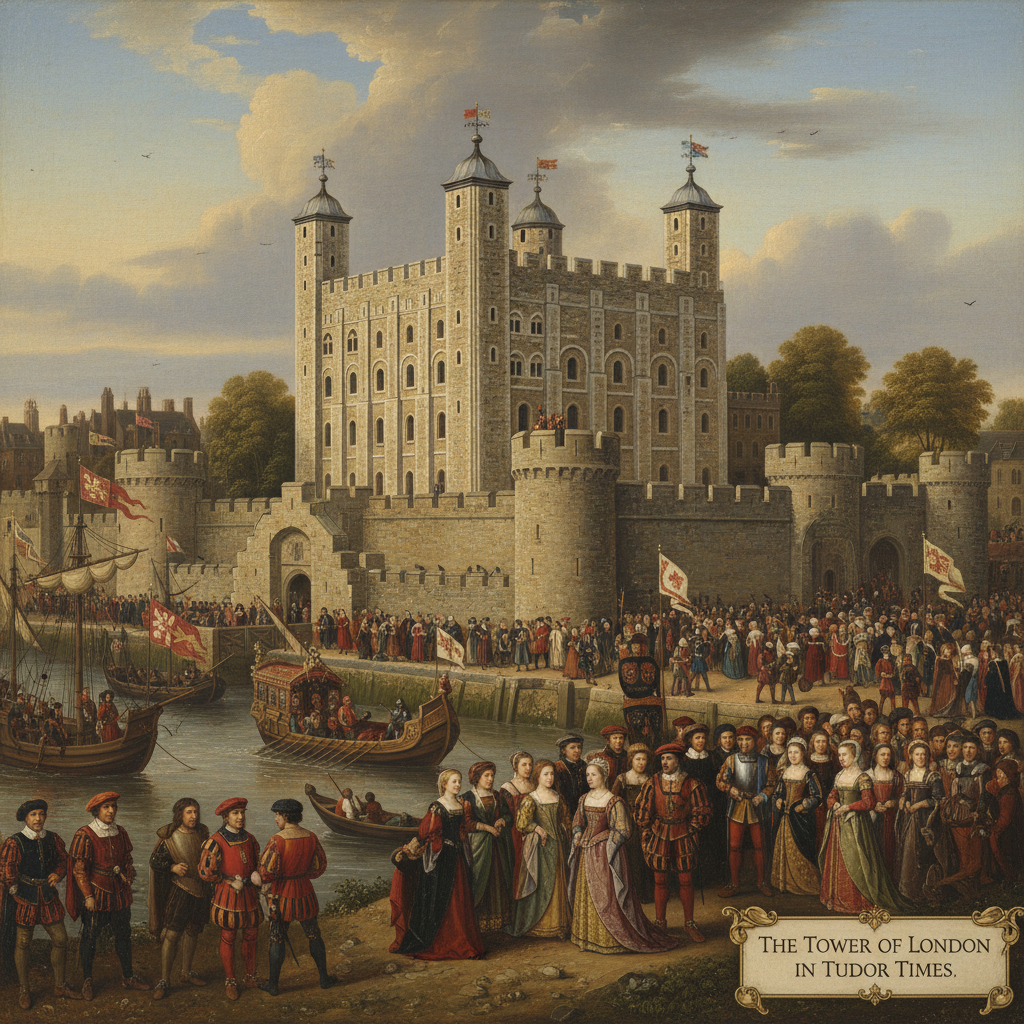
The Tower of London: Tudor England's Grim Fortress
Explore the chilling history of the Tower of London during the Tudor era, a fortress that served as a royal palace, treasury, and most famously, a state prison for figures like Anne Boleyn and Lady Jane Grey. Discover its role in shaping England's tumultuous past.

Hampton Court Palace: A Tudor Masterpiece and Royal Powerhouse
Explore the history of Hampton Court Palace, the magnificent Tudor residence built by Cardinal Wolsey and seized by Henry VIII. Discover the Great Hall, the Royal Tennis Court, and the dramatic stories of the six queens.

The Tower of London: Citadel of Power in the Tudor Era
Explore the Tower of London during the Tudor era (1485–1603), examining its transformation from a royal palace and treasury into the infamous state prison that housed and executed figures like Anne Boleyn and Catherine Howard.

The Enduring Charm of Tudor Half-Timbered Houses
Explore the iconic half-timbered architecture of the Tudor era. Learn how these distinctive black-and-white houses served as status symbols, reflected the 'Great Rebuilding,' and utilized innovative construction techniques.