The English Reformation: A Kingdom Transformed
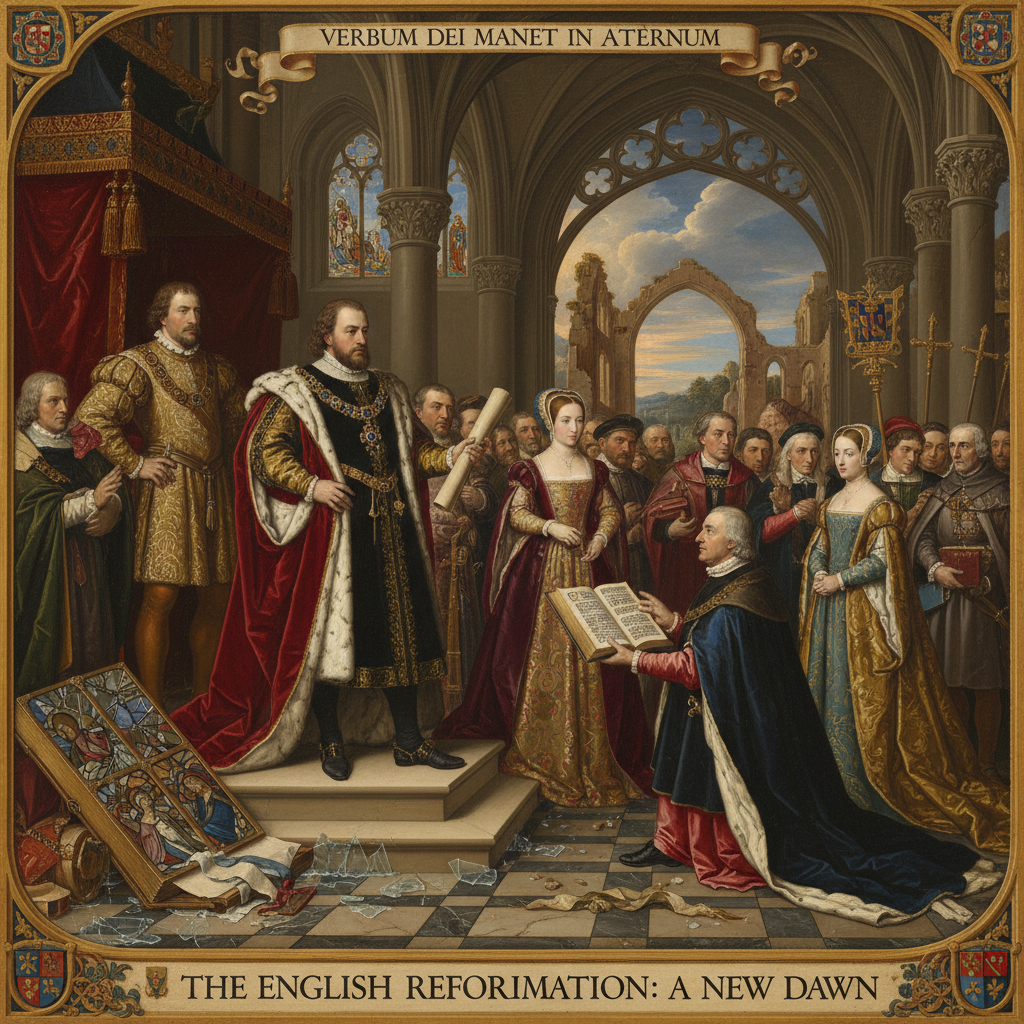
Imagine a world where your monarch, not the Pope, dictates your spiritual life. A world where ancient monasteries are dissolved, their treasures seized, and their inhabitants cast out. This was the seismic shift that gripped England in the 16th century, a period known as the English Reformation. Far from a purely theological debate, this was a revolution born of royal ambition, political maneuvering, and burgeoning religious dissent, irrevocably altering the fabric of English society, church, and state. It was a drama played out on a grand stage, with kings, queens, martyrs, and reformers all playing their part in forging a new national identity.
The King's 'Great Matter': Henry VIII and the Break with Rome
The catalyst for the English Reformation is famously attributed to King Henry VIII's desperate desire for a male heir. His marriage to Catherine of Aragon, widow of his elder brother Arthur, had produced only one surviving child, Princess Mary. Convinced that his lack of a son was divine punishment for marrying his brother's wife (a union forbidden in Leviticus), Henry sought an annulment from Pope Clement VII. This was no simple request; Catherine was the aunt of the powerful Holy Roman Emperor Charles V, and the Pope was effectively his prisoner.
For years, Henry's 'Great Matter' dragged on, frustrating the king and pushing him to increasingly radical solutions. His chief minister, Cardinal Thomas Wolsey, failed to secure the annulment and was eventually disgraced and arrested. Into the void stepped new figures: Thomas Cranmer, a theologian with Protestant leanings, and Thomas Cromwell, a shrewd lawyer and administrator. These men would become instrumental in dismantling papal authority in England.
The decisive break came not from a theological epiphany, but from a series of legislative acts passed by the 'Reformation Parliament' (1529-1536). The Act in Restraint of Appeals (1533) prevented appeals to Rome, effectively making the King the final legal authority in England. The Act of Supremacy (1534) declared Henry VIII to be the "Supreme Head of the Church of England," severing centuries of papal jurisdiction. This was a monumental assertion of royal power, establishing the monarch as the ultimate authority in both temporal and spiritual matters.
“The King's Majesty is, under God, the Supreme Head of the Church of England, and hath full power and authority to correct, punish, and repress all such errors, heresies, abuses, offences, contempts and enormities, whatsoever they be, which by any manner spiritual authority or jurisdiction ought or may lawfully be reformed, repressed, ordered, redressed, corrected, restrained or amended.”
– Act of Supremacy, 1534
The Dissolution of the Monasteries: A Wealth of Change
With the Pope's authority gone, Henry VIII and Cromwell turned their attention to the vast wealth and influence of England's monasteries. These institutions, often the largest landowners in their regions, were seen as bastions of papal loyalty and potential sources of opposition to the King's new supremacy. Cromwell initiated a comprehensive survey, the Valor Ecclesiasticus, to assess their wealth, followed by visitations to uncover alleged corruption and moral laxity.
The findings, often exaggerated, provided the pretext for their dissolution. Between 1536 and 1540, over 800 monasteries, priories, nunneries, and friaries were systematically closed. Their lands, buildings, and vast treasures – gold, silver, jewels, and lead from roofs – were confiscated by the Crown. This act had profound consequences:
- **Economic Impact:** The Crown's coffers swelled, funding Henry's wars and lavish lifestyle. The sale of monastic lands created a new class of gentry, loyal to the Tudor regime.
- **Social Upheaval:** Thousands of monks, nuns, and friars were displaced, many left destitute. Monasteries had been centers of charity, education, and healthcare, and their loss created a vacuum in many communities.
- **Cultural Destruction:** Irreplaceable libraries, artworks, and architectural masterpieces were lost or destroyed.
- **Religious Shift:** The dissolution removed a significant pillar of traditional Catholic piety and paved the way for more Protestant-leaning reforms.
Did You Know?
The lead from the roofs of dissolved monasteries was so abundant that it was melted down and used to make bullets and pipes, and even exported, contributing significantly to the Crown's income.
Edward VI: The Protestant Tide
Henry VIII died in 1547, leaving his nine-year-old son, Edward VI, on the throne. Edward, a devout and intelligent boy, had been raised with strong Protestant convictions. Under the guidance of his regents, primarily Edward Seymour, Duke of Somerset, and later John Dudley, Duke of Northumberland, the English Church moved decisively towards Protestantism.
Key reforms during Edward's reign included:
- The introduction of the Book of Common Prayer (1549, revised 1552), which replaced the Latin Mass with English services and emphasized congregational participation.
- The removal of images, altars, and stained glass from churches, deemed idolatrous.
- The legalization of clerical marriage.
- The Forty-Two Articles of Religion (1553), outlining a distinctly Protestant theology.
These changes were met with both enthusiasm and resistance, notably the Prayer Book Rebellion in the West Country in 1549. Edward's reign, though short, laid much of the theological and liturgical groundwork for the future Church of England.
Mary I: A Catholic Restoration, Briefly
Edward VI's death in 1553 brought his older half-sister, Mary I, to the throne. A staunch Catholic, Mary was determined to reverse the Reformation and restore England to papal obedience. She married Philip II of Spain, a fervent Catholic, and began a systematic undoing of her father's and brother's reforms.
Parliament repealed the Acts of Supremacy and Uniformity, and papal authority was formally restored. The Latin Mass returned, and married clergy were forced to separate from their wives. Most tragically, Mary's reign earned her the moniker "Bloody Mary" due to the persecution of Protestants. Nearly 300 religious dissenters, including Archbishop Thomas Cranmer, were burned at the stake for heresy. This brutal suppression, however, often had the unintended effect of strengthening Protestant resolve and creating martyrs, further embedding Protestantism in the national consciousness.
Elizabeth I: The Elizabethan Settlement
Mary's death in 1558 brought her Protestant half-sister, Elizabeth I, to the throne. Elizabeth inherited a kingdom deeply divided by religion. Her genius lay in forging a compromise, known as the Elizabethan Religious Settlement, designed to bring stability and unity to the realm.
The settlement, enacted through the Act of Supremacy (1559) and the Act of Uniformity (1559), re-established the monarch as the Supreme Governor of the Church of England (a slightly softer title than "Supreme Head"). It reinstated an updated version of the Book of Common Prayer, which was deliberately ambiguous enough to be acceptable to both moderate Protestants and traditional Catholics. Church doctrine was outlined in the Thirty-Nine Articles (1563), leaning towards Protestant theology but retaining some Catholic traditions in practice and liturgy.
“I have no desire to make windows into men's souls.”
– Elizabeth I, on religious conformity
Elizabeth's policy was one of outward conformity rather than strict theological adherence. While radical Puritans (who sought further Protestant reform) and recusant Catholics (who refused to attend Anglican services) faced varying degrees of persecution, the settlement largely succeeded in establishing a stable, national church that endured for centuries. It was a pragmatic solution that prioritized national unity over dogmatic purity, a hallmark of Elizabeth's reign.
The Enduring Legacy of the English Reformation
The English Reformation was not a single event but a complex, decades-long process with profound and lasting consequences. It fundamentally reshaped England's identity, severing its ties with the Roman Catholic Church and establishing a unique national church with the monarch at its head. This shift had ripple effects across all aspects of society:
- **Political Power:** It consolidated royal authority, making the monarch the supreme power in the land.
- **National Identity:** It fostered a distinct English identity, often defined in opposition to Catholic Europe.
- **Cultural Impact:** It spurred the development of English as a liturgical language and influenced literature, music, and art.
- **Social Change:** It redistributed wealth and power, contributing to the rise of new social classes.
- **Religious Landscape:** It created a diverse religious landscape, leading to the emergence of various Protestant denominations and the continued, though often suppressed, presence of Catholicism.
From Henry VIII's desperate quest for an heir to Elizabeth I's shrewd political balancing act, the English Reformation was a turbulent yet transformative period. It laid the foundations for modern Britain, a testament to the enduring power of faith, ambition, and the relentless march of history. Understanding this era is crucial to comprehending the subsequent centuries of English and British history, from the English Civil War to the present day.
TAGS
Discussion
No comments yet
Be the first to share your thoughts on this article!
You May Also Like
Continue exploring Tudor history with these related articles

The English Reformation: How Henry VIII Changed England Forever
Explore the dramatic political and religious upheaval of the English Reformation, driven by Henry VIII's quest for a male heir. Discover how the break with Rome, the dissolution of monasteries, and the subsequent religious swings under Edward VI, Mary I, and Elizabeth I fundamentally reshaped England's culture, economy, and national identity.

The Eye of the Queen: Francis Walsingham's Tudor Spy Network
Explore the shadowy world of Tudor espionage under Queen Elizabeth I. Discover how Sir Francis Walsingham, the 'Queen's Spymaster,' built the most sophisticated intelligence network in Europe, utilizing codebreakers, double agents, and foreign informers to thwart Catholic plots, secure the execution of Mary, Queen of Scots, and pave the way for the defeat of the Spanish Armada.

The Pilgrimage of Grace: A Tudor Rebellion Unveiled
Explore the Pilgrimage of Grace, the massive 1536 Tudor rebellion against Henry VIII's religious reforms and the dissolution of monasteries. Discover its causes, key figures, and brutal suppression.
Shadows and Secrets: Walsingham's Tudor Spy Network
Dive into the shadowy world of Tudor espionage with Sir Francis Walsingham, Queen Elizabeth I's spymaster. Discover how his intricate network of agents, codebreakers, and double agents protected England from countless plots and conspiracies, ensuring the Queen's survival and the stability of the realm.