The English Reformation: How Henry VIII Changed England Forever

The English Reformation was not a sudden theological awakening but a seismic political shift, driven by the personal desires of a powerful monarch, King Henry VIII. Unlike the continental Reformation, which began with Martin Luther’s spiritual crisis, the English version started in the royal court, catalyzed by the King’s desperate need for a male heir and his obsession with Anne Boleyn. This momentous period, beginning in the 1530s, irrevocably severed England’s centuries-old ties with Rome, dismantled the medieval Church, and laid the groundwork for the modern British state. To understand the Tudor era, one must first grasp the profound and often brutal consequences of this religious revolution.
The King’s 'Great Matter': Dynastic Crisis and Royal Supremacy
At the heart of the initial break with Rome lay the 'King’s Great Matter'—Henry VIII’s desire to annul his marriage to Catherine of Aragon. After two decades of marriage, Catherine had failed to produce a surviving male heir, leaving only Princess Mary. Fearing a succession crisis reminiscent of the Wars of the Roses, Henry became convinced that his marriage was cursed, citing the biblical passage in Leviticus (which forbade marrying a brother's wife, as Catherine had been married to Henry's deceased brother, Arthur). Henry sought papal dispensation, but Pope Clement VII, effectively a prisoner of the Holy Roman Emperor Charles V (Catherine’s nephew), could not grant the annulment without severe political repercussions.
Frustrated by years of legal wrangling and increasingly captivated by Anne Boleyn, Henry turned to his chief ministers, Thomas Cromwell and Thomas Cranmer, to find a domestic solution. This solution was radical: asserting that the King, not the Pope, held ultimate authority over the Church in England.
The Legislative Revolution (1532–1534)
Cromwell orchestrated a series of parliamentary acts that systematically dismantled papal authority. These acts were the legal foundation of the new Church of England:
- The Act in Restraint of Appeals (1533): Declared that England was an 'Empire,' meaning the King held supreme authority and no appeals could be made to foreign courts (i.e., Rome). This cleared the way for Archbishop Cranmer to declare Henry’s marriage to Catherine null and void.
- The Act of Supremacy (1534): Officially declared Henry VIII the 'Supreme Head of the Church of England.' This was the definitive break, establishing the King's absolute control over ecclesiastical matters, doctrine, and appointments.
- The Treasons Act (1534): Made it high treason to deny the King's titles, including Supreme Head. This act was used to silence dissenters, most famously Sir Thomas More and Bishop John Fisher.
“Whereby, by divers sundry old authentic histories and chronicles, it is manifestly declared and expressed that this realm of England is an Empire, and so hath been accepted in the world, governed by one supreme head and king having the dignity and royal estate of the imperial crown of the same.” —Preamble to the Act in Restraint of Appeals (1533)
The Destruction of Monastic Life: Wealth and Power
Once the King was established as Supreme Head, the next logical step was to seize the immense wealth held by the monasteries. Monasteries controlled vast tracts of land—perhaps a quarter of the arable land in England—and represented a powerful, often independent, source of spiritual and economic power that still answered ultimately to Rome.
Under Cromwell’s direction, visitors were dispatched across the country to assess the monastic houses, ostensibly looking for corruption and moral failure. The resulting reports, often exaggerated or fabricated, provided the pretext for dissolution.
The Dissolution of the Monasteries (1536–1541)
The process began with the smaller monasteries (those worth less than £200 annually) in 1536 and concluded with the great abbeys, such as Glastonbury and Fountains, by 1541. The consequences were profound:
- Economic Shift: The Crown gained enormous wealth, which Henry spent quickly on foreign wars and lavish building projects. This influx of land created a new class of gentry who bought up the former monastic estates, cementing their loyalty to the new religious order.
- Social Upheaval: Thousands of monks, nuns, and lay servants were displaced. While some received pensions, many were left destitute.
- Cultural Loss: Libraries were destroyed, priceless illuminated manuscripts were lost, and magnificent Gothic buildings were stripped of lead and stone.
Did You Know?
The total wealth seized from the monasteries during the Dissolution is estimated to be over £1.5 million (an astronomical sum at the time), equivalent to roughly ten years of Henry VIII's normal annual income. This massive injection of capital fundamentally altered the English economy and royal finances.
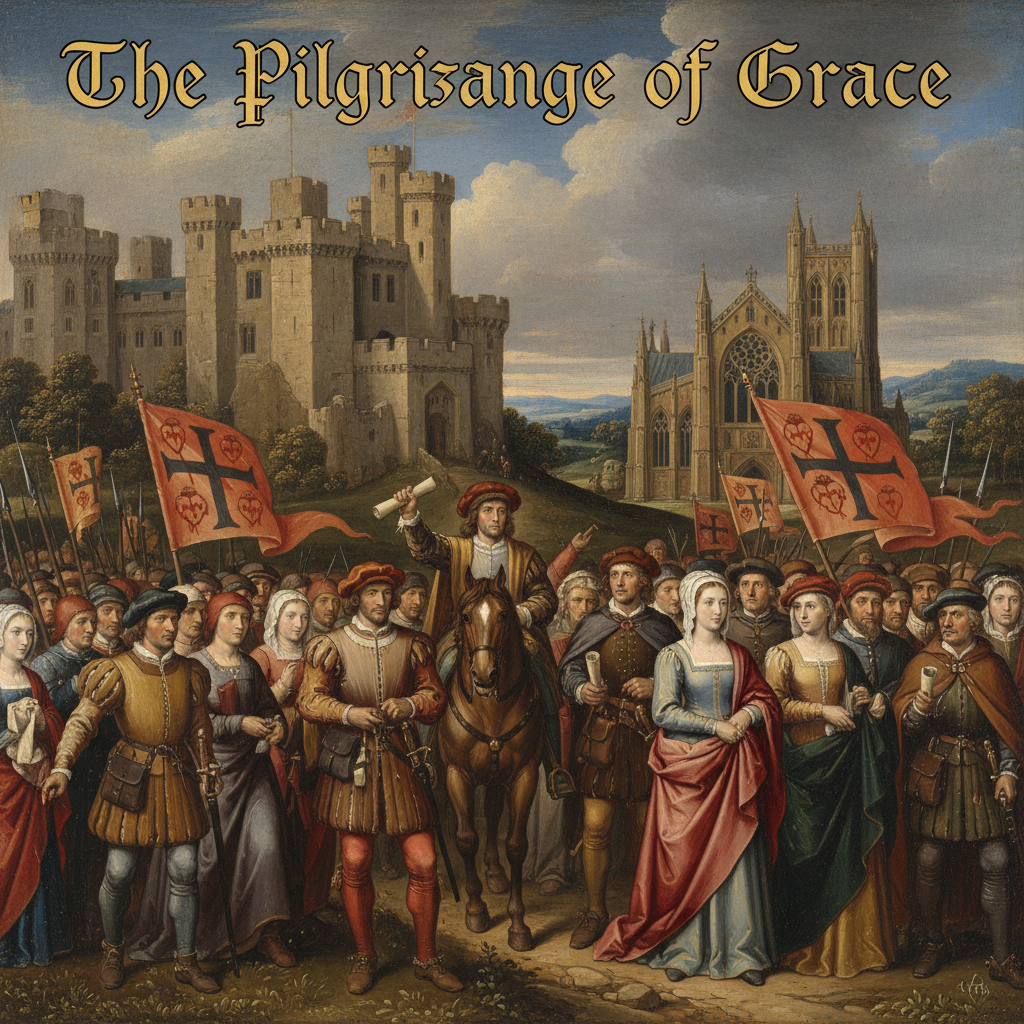
The dissolution provoked the largest single rebellion of the Tudor period: the Pilgrimage of Grace in 1536. Tens of thousands of rebels in the north marched to protest the religious changes and the destruction of their local spiritual centres. Henry brutally suppressed the uprising, demonstrating the ruthlessness with which he would enforce the Royal Supremacy.
The Pendulum Swings: From Henry VIII to Elizabeth I
The Reformation did not follow a straight line; it was a constant, often violent, theological tug-of-war throughout the reigns of Henry’s children.
Edward VI (1547–1553): Radical Protestantism
Under Henry’s young son, Edward VI, guided by staunchly Protestant regents (Somerset and Northumberland), the Church moved sharply toward Calvinism. Images were removed from churches, Latin Mass was abolished, and the first two English Prayer Books (written by Thomas Cranmer) were introduced, emphasizing Protestant theology. This period saw the first widespread persecution of Catholics.
Mary I (1553–1558): The Catholic Restoration
Mary I, daughter of Catherine of Aragon, was determined to undo her father’s work. She restored papal authority, repealed the Protestant legislation, and began the systematic persecution of Protestants, earning her the moniker 'Bloody Mary.' Nearly 300 Protestants, including Archbishop Cranmer, were burned at the stake. Mary’s reign proved that the Reformation was far from settled, but her methods ultimately solidified anti-Catholic sentiment among the English populace.
“I will not recant, for that which I have written, I believe to be true; and if I were to recant, I should be a liar and a hypocrite.” —Thomas Cranmer, moments before his execution, recanting his earlier forced recantations (1556)
The Elizabethan Settlement: A Lasting Compromise
When Elizabeth I ascended the throne in 1558, England was religiously exhausted and deeply divided. Elizabeth, pragmatic and politically astute, sought a middle path—a compromise that would satisfy the majority and ensure stability. This was the Elizabethan Religious Settlement.
The Settlement re-established the Church of England as Protestant, with the monarch as the Supreme Governor (a slightly softer title than Henry's 'Supreme Head'). The 1559 Acts of Supremacy and Uniformity mandated the use of a revised Prayer Book (which was deliberately vague enough to be interpreted by both moderate Protestants and traditional Catholics) and enforced compulsory church attendance.
Elizabeth’s policy was one of outward conformity: as long as subjects attended the parish church and did not actively challenge the Crown, their private beliefs were largely tolerated. This strategic ambiguity allowed the Church of England to become a unique entity—Protestant in doctrine, but retaining much of the ceremonial structure of the medieval Church.
Legacy of the Reformation
The English Reformation was more than just a change in liturgy; it was a foundational moment for English identity. It shifted political power from the Church to the State, centralized authority in the monarchy, and fostered a strong sense of national exceptionalism that would define England’s relationship with Europe for centuries. It fueled internal conflicts, shaped the rise of Puritanism, and ultimately led to the establishment of the Anglican Communion, a global religious body that persists today. The echoes of Henry VIII’s 'Great Matter' still reverberate through the halls of Westminster and Canterbury, reminding us that the Tudors did not just rule England—they remade it.
TAGS
Discussion
No comments yet
Be the first to share your thoughts on this article!
Related Articles
The Pilgrimage of Grace: A Tudor Rebellion Unveiled
Explore the Pilgrimage of Grace, the massive 1536 Tudor rebellion against Henry VIII's religious reforms and the dissolution of monasteries. Discover its causes, key figures, and brutal suppression.

The Eye of the Queen: Francis Walsingham's Tudor Spy Network
Explore the shadowy world of Tudor espionage under Queen Elizabeth I. Discover how Sir Francis Walsingham, the 'Queen's Spymaster,' built the most sophisticated intelligence network in Europe, utilizing codebreakers, double agents, and foreign informers to thwart Catholic plots, secure the execution of Mary, Queen of Scots, and pave the way for the defeat of the Spanish Armada.