The Pilgrimage of Grace: A Tudor Rebellion Unveiled
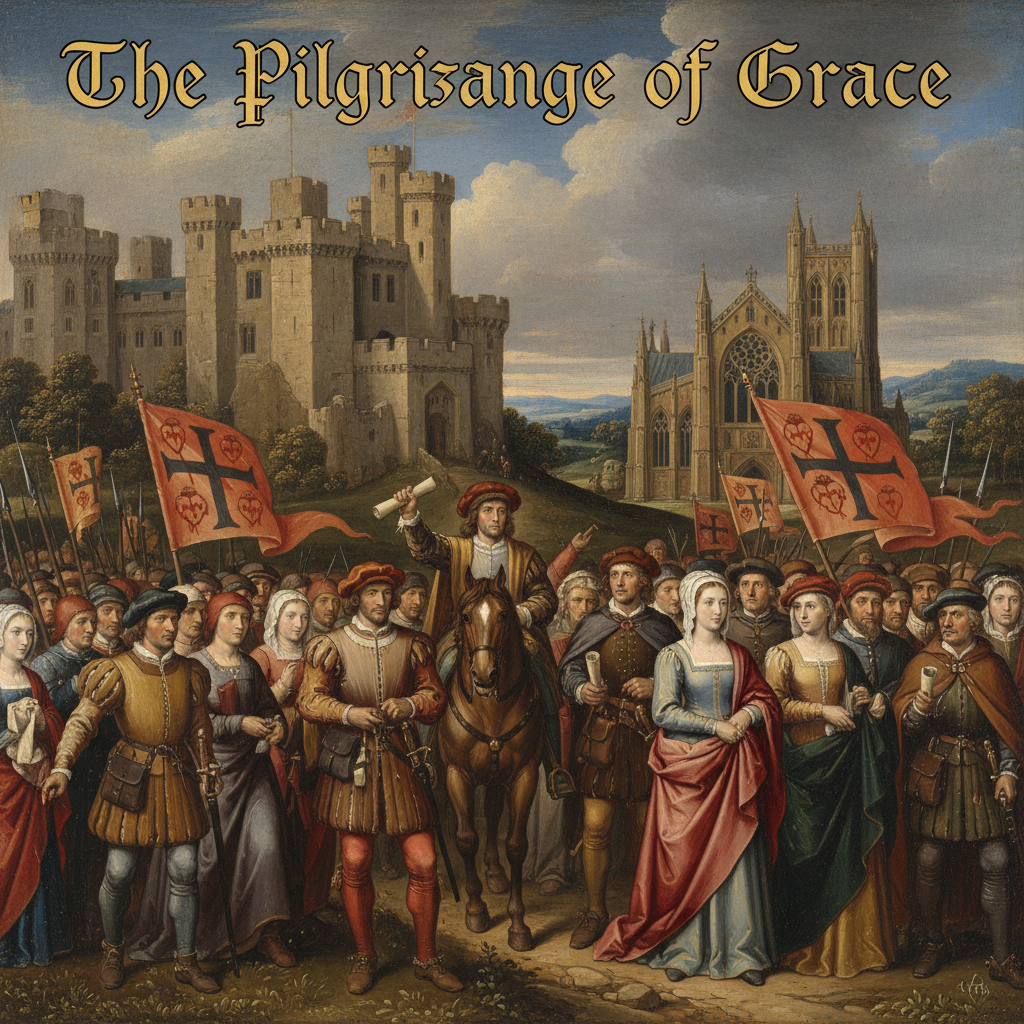
In the autumn of 1536, England teetered on the brink of civil war. Not since the Wars of the Roses had the Crown faced such widespread and fervent opposition. From the windswept dales of Yorkshire to the ancient streets of Lincoln, tens of thousands of ordinary men, noblemen, and clergy rose in a massive rebellion known as the Pilgrimage of Grace. This was no mere riot; it was a carefully organized, religiously motivated protest against the seismic changes wrought by King Henry VIII's Reformation, a desperate plea to preserve a way of life that was rapidly being dismantled.
The Seeds of Discontent: Henry VIII's Reformation
The Pilgrimage of Grace did not erupt in a vacuum. Its roots lay deep in the tumultuous ecclesiastical reforms initiated by Henry VIII. His desire for a male heir and his infatuation with Anne Boleyn had led him to break with the Roman Catholic Church, declare himself Supreme Head of the Church of England, and dissolve the monasteries. While these changes were met with varying degrees of acceptance in the south, they were profoundly unpopular in the staunchly Catholic north of England.
The dissolution of the smaller monasteries, begun in 1536, was a particularly potent catalyst. These institutions were not just religious houses; they were vital parts of the community. They provided education, healthcare, alms for the poor, and employment. Their destruction meant the loss of spiritual comfort, economic stability, and familiar social structures. Moreover, the Crown's commissioners, often seen as greedy outsiders, were perceived as desecrating sacred sites and plundering local wealth.
“The King's Grace has been ill-advised by certain evil counsellors, who seek to destroy the ancient faith and good customs of this realm.”
— Robert Aske, leader of the Pilgrimage of Grace
Beyond the monasteries, other grievances simmered. New taxes, particularly the Subsidy Act of 1534, were resented. Fears abounded that parish churches and even private property would be next on the Crown's list for seizure. There was also a deep-seated distrust of Henry's chief minister, Thomas Cromwell, and other 'new men' at court, who were seen as heretical reformers leading the King astray.
The Lincolnshire Rising: The First Spark
The first flames of rebellion ignited in Lincolnshire in early October 1536. Prompted by the arrival of royal commissioners to dissolve local monasteries and collect taxes, the people of Louth, Horncastle, and other towns rose up. They seized the commissioners, murdered the Bishop of Lincoln's chancellor, and marched on Lincoln, swelling their ranks to thousands. Their demands, articulated in the 'Lincoln Articles,' called for an end to the dissolution of monasteries, the removal of 'evil counsellors' like Cromwell, and the restoration of traditional religious practices.
Did You Know?
The Lincolnshire rebels initially tried to distance themselves from the term 'rebellion,' calling their movement a 'commonwealth' to imply legitimate protest rather than treason against the King.
However, the Lincolnshire Rising was relatively short-lived. Henry VIII responded swiftly and decisively, dispatching a large royal army under the Duke of Suffolk. Faced with the prospect of confronting the King's forces, and lacking strong leadership, the rebels began to disperse. Their leaders were arrested, and the movement fizzled out within weeks. Yet, the embers of discontent were far from extinguished; they merely shifted north.
The Pilgrimage of Grace: A Northern Storm
As the Lincolnshire Rising faltered, a far more formidable movement was gathering strength in Yorkshire. Led by the charismatic lawyer Robert Aske, the 'Pilgrimage of Grace for the Commonwealth' began around October 10th. Aske, a gentleman of good standing, provided the leadership and organizational skill that the Lincolnshire rebels lacked. He insisted on discipline, forbade looting, and framed the movement not as a rebellion, but as a peaceful 'pilgrimage' to restore the true faith and 'purify' the realm.
The rebels adopted a banner depicting the Five Wounds of Christ, and their members wore badges with the same symbol, emphasizing their religious motivation. Their oath bound them to God, the King, and the 'Commonwealth,' promising to preserve the Church and expel 'heretics' from the King's council.
- Key Demands:
- Reversal of the dissolution of monasteries
- Restoration of papal authority (or at least traditional Catholic doctrine)
- Removal of 'heretical' advisors like Thomas Cromwell and Archbishop Cranmer
- Legitimisation of Princess Mary (Henry's daughter by Catherine of Aragon)
- Repeal of the Statute of Uses (a land law that benefited the Crown)
The Pilgrimage quickly gained momentum. York, the ancient capital of the north, fell to Aske's forces without a fight. Pontefract Castle, a key strategic stronghold, was also taken. By late October, Aske commanded an army estimated at 30,000 to 40,000 men, including many northern gentry and even some members of the clergy, such as the Abbot of Rievaulx.
Henry VIII, initially dismissive, was now genuinely alarmed. He sent the Duke of Norfolk with a smaller royal army to confront the rebels. However, Norfolk, a cautious and pragmatic commander, realized his forces were outnumbered and that many of his own men sympathized with the Pilgrims. Instead of fighting, he opted for negotiation.
The Pontefract Articles and Royal Deceit
At Doncaster, in late October, Norfolk met with Aske and other rebel leaders. Aske presented the 'Pontefract Articles,' a comprehensive list of 24 demands covering religious, economic, and political grievances. These articles went far beyond the Lincolnshire demands, challenging the very foundations of Henry's Reformation.
Norfolk, acting on Henry's instructions, promised a general pardon for all participants, a truce, and a parliament to be held in York to discuss their demands. Aske, believing the King would honor his word, persuaded his followers to disperse. The Pilgrims returned home, trusting in the King's clemency and the promise of redress.
The Aftermath: Betrayal and Brutality
Henry VIII, however, had no intention of keeping his promises. He saw the Pilgrimage of Grace as an act of treason and was simply biding his time. The promised parliament never materialized. Instead, a series of smaller, uncoordinated uprisings, often fueled by fear and suspicion of the King's intentions, broke out in early 1537, particularly in Cumberland and Westmorland.
These 'renewed rebellions' gave Henry the pretext he needed. He declared that the Pilgrims had broken the terms of the pardon and unleashed a brutal crackdown. Norfolk, now with reinforced troops, was ordered to suppress all dissent mercilessly. Hundreds of rebels were arrested and executed, often by hanging, drawing, and quartering. Monasteries that had been reoccupied by the Pilgrims were dissolved with renewed ferocity.
The Fate of the Leaders
Robert Aske, who had been invited to court by Henry and even dined with him over Christmas 1536, was arrested in April 1537. He was tried for treason and hanged in chains from the walls of York Castle, his body left to rot as a warning. Many other leaders, including Lord Hussey, Lord Darcy, and several abbots, met similar fates. The executions were designed to be a terrifying spectacle, ensuring no further challenge to royal authority.
The Pilgrimage of Grace ultimately failed in its immediate objectives. The dissolution of the monasteries continued unabated, and Henry's religious reforms were cemented. However, its legacy is profound. It demonstrated the depth of popular resistance to the Reformation and forced Henry to proceed more cautiously with further changes. It also highlighted the vulnerability of the Tudor regime when faced with widespread, organized opposition.
Legacy and Interpretation
The Pilgrimage of Grace remains one of the most significant events in Tudor history. It was a moment when the common people, alongside their traditional leaders, attempted to halt the tide of religious and social change. Historians continue to debate its true nature: was it primarily a religious crusade, a social protest against economic hardship, or a political maneuver by disgruntled nobles?
While religious devotion was undoubtedly a powerful motivator, the economic and social grievances were inextricably linked. The monasteries were not just spiritual centers; they were economic engines and social safety nets. Their destruction impacted every aspect of northern life.
The Pilgrimage also serves as a stark reminder of Henry VIII's ruthlessness and his unwavering determination to assert royal supremacy. His betrayal of the rebels, despite promises of pardon, solidified his reputation as a monarch who would tolerate no challenge to his authority, no matter how 'gracious' the protest claimed to be.
For those interested in Tudor history, the Pilgrimage of Grace offers a compelling glimpse into the complexities of a nation grappling with radical transformation. It underscores the human cost of political and religious upheaval and the enduring power of faith and community in the face of absolute power. It is a story of courage, conviction, and ultimately, tragic defeat, but one that shaped the future of England forever.
TAGS
Discussion
No comments yet
Be the first to share your thoughts on this article!
Related Articles

The Eye of the Queen: Francis Walsingham's Tudor Spy Network
Explore the shadowy world of Tudor espionage under Queen Elizabeth I. Discover how Sir Francis Walsingham, the 'Queen's Spymaster,' built the most sophisticated intelligence network in Europe, utilizing codebreakers, double agents, and foreign informers to thwart Catholic plots, secure the execution of Mary, Queen of Scots, and pave the way for the defeat of the Spanish Armada.

The English Reformation: How Henry VIII Changed England Forever
Explore the dramatic political and religious upheaval of the English Reformation, driven by Henry VIII's quest for a male heir. Discover how the break with Rome, the dissolution of monasteries, and the subsequent religious swings under Edward VI, Mary I, and Elizabeth I fundamentally reshaped England's culture, economy, and national identity.