Sir Francis Drake: Pirate or Hero of the Tudor Age?
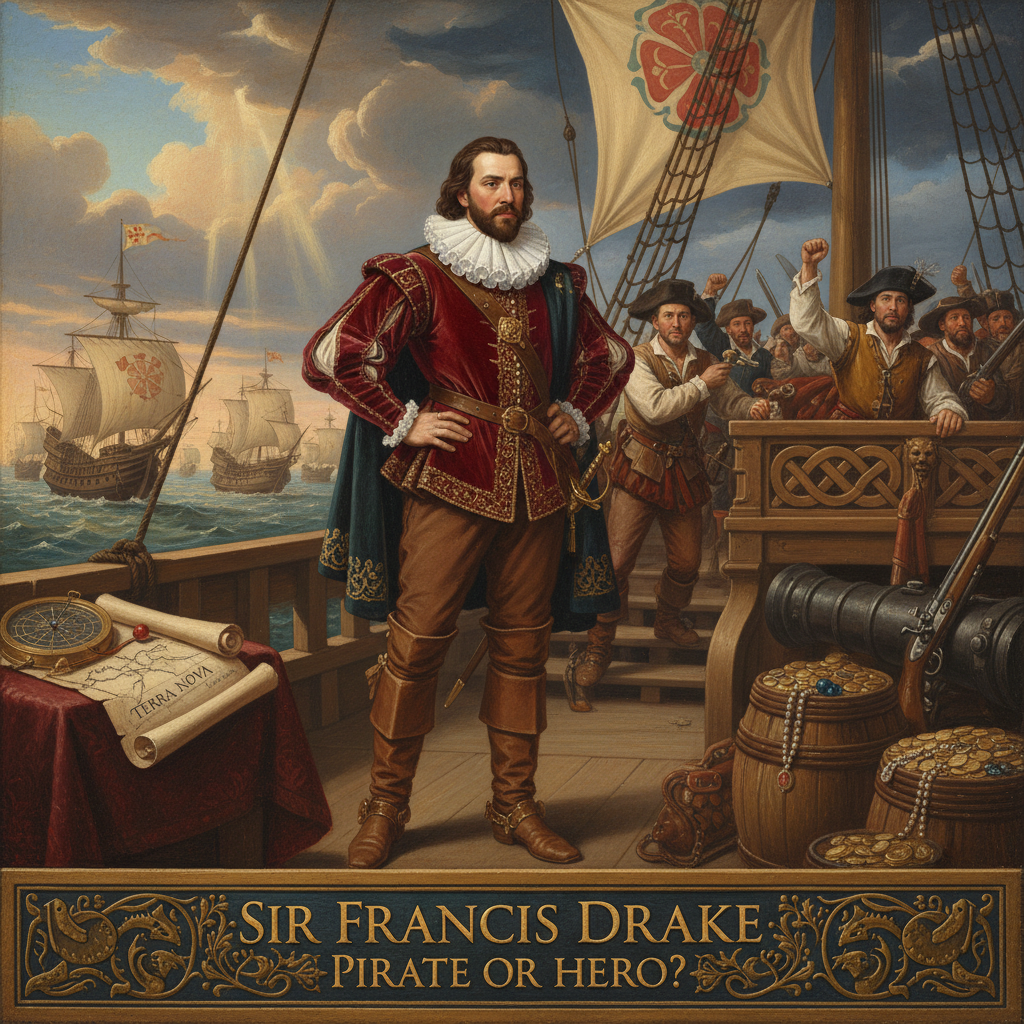
Few figures in Tudor history ignite as much debate and fascination as Sir Francis Drake. To the English, he was a daring explorer, a national hero, and a scourge of their greatest enemy, Spain. To the Spanish, he was 'El Draque' – a notorious pirate, a Protestant heretic, and a relentless plunderer of their New World riches. Was he a swashbuckling adventurer driven by patriotism and a thirst for discovery, or a ruthless privateer motivated by greed and sanctioned by a queen? The truth, as often is the case with history's most compelling characters, lies somewhere in the complex interplay of these perceptions.
The Making of a Seadog: Drake's Early Life and Voyages
Born into a Protestant farming family in Tavistock, Devon, around 1540, Francis Drake's early life was marked by religious persecution. His family fled to Kent to escape the Catholic persecutions under Queen Mary I, where his father became a chaplain to the navy. This early exposure to the sea, combined with his Protestant upbringing, undoubtedly shaped his worldview and his future animosity towards Catholic Spain.
Drake began his seafaring career at a young age, apprenticing on a small coastal vessel. By his early twenties, he was commanding his own ship, engaging in trade and, increasingly, in the burgeoning, often brutal, transatlantic slave trade alongside his cousin, John Hawkins. These voyages to the Spanish Main – the northern coast of South America – were fraught with danger, as Spain fiercely protected its colonial monopoly. It was during these encounters that Drake's deep-seated animosity towards Spain began to solidify, fueled by Spanish attacks on English traders, notably at San Juan de Ulúa in 1568, where Drake and Hawkins barely escaped with their lives.
From Plymouth to the Spanish Main: Early Raids
Drake's early independent voyages, particularly those between 1570 and 1573, were characterized by audacious raids on Spanish settlements and treasure convoys. These were not mere acts of piracy in the traditional sense, but rather privateering expeditions, often carried out with tacit, if not explicit, approval from powerful English patrons who sought to undermine Spanish power and fill English coffers. His most famous early exploit was the capture of the Spanish treasure train at Nombre de Dios in 1573, where he reportedly saw the Pacific Ocean for the first time, sparking a dream of sailing its waters.
"I have brought you the keys of the Indies!"
— Allegedly said by Francis Drake to Queen Elizabeth I upon his return from a successful raid.
Did You Know?
During his 1573 raid on Nombre de Dios, Drake was shot in the leg but continued to lead his men until he collapsed from blood loss, forcing them to retreat.
The Circumnavigation: A Daring Feat of Exploration and Plunder
Drake's most celebrated achievement, and perhaps the most controversial, was his circumnavigation of the globe between 1577 and 1580. Commissioned by Queen Elizabeth I, this voyage aboard the Golden Hind (originally the Pelican) was ostensibly an exploratory mission to find new trade routes. However, its true purpose was a thinly veiled campaign of harassment and plunder against Spanish interests in the Pacific, a region previously untouched by English privateers.
Sailing through the treacherous Strait of Magellan, Drake emerged into the Pacific, where he proceeded to raid Spanish ports and treasure ships along the coasts of Chile and Peru with impunity. The Spanish, completely unprepared for an English presence in their 'Pacific Lake,' were taken by surprise. The most famous prize was the treasure ship Nuestra Señora de la Concepción, known as 'Cacafuego,' laden with an immense cargo of gold, silver, and jewels.
Drake's return to England in 1580 was met with rapturous celebration. He had not only completed the second circumnavigation of the world (after Magellan's expedition), but he had also brought back an astonishing amount of wealth – enough to pay off the national debt and provide a substantial profit for the Queen and his investors. Elizabeth I, despite Spanish protests and demands for Drake's execution as a pirate, publicly knighted him aboard the Golden Hind at Deptford, solidifying his status as a national hero and her 'privateer.'
The Armada and Beyond: Defender of England
Drake's role in the defeat of the Spanish Armada in 1588 cemented his legendary status in England. As Vice-Admiral of the English fleet, he played a crucial part in the naval engagements that ultimately scattered and destroyed Philip II's 'Invincible Armada.' His famous, though perhaps apocryphal, anecdote of finishing a game of bowls before setting sail to meet the Spanish fleet perfectly encapsulates his confident, daring persona.
- 1587: The 'Singeing of the King of Spain's Beard' – Drake led a daring raid on Cádiz harbor, destroying numerous Spanish ships and supplies, delaying the Armada's launch by a year.
- 1588: Battle of Gravelines – Drake's ships, alongside others, helped unleash fire ships against the anchored Armada, breaking their formation and forcing them into the open sea.
- Strategic Acumen – While not the supreme commander, Drake's experience and aggressive tactics were invaluable in the English victory.
Following the Armada's defeat, Drake continued to lead expeditions against Spanish interests, though with less consistent success. His later years saw him attempting to capture Spanish colonial strongholds in the Caribbean, but these ventures proved more challenging. He died of dysentery in 1596 off the coast of Portobelo, Panama, and was buried at sea in a lead coffin.
Legacy: Pirate, Hero, or Both?
So, was Sir Francis Drake a pirate or a hero? From a modern perspective, his actions – particularly his involvement in the slave trade and his aggressive plundering – are deeply problematic. However, to judge him solely by contemporary moral standards would be anachronistic. In the context of the late 16th century, a period of intense religious and political rivalry between England and Spain, his actions were viewed very differently.
For England, Drake was undeniably a hero. He was a symbol of English naval prowess, a defender of Protestantism, and a key figure in challenging Spain's global dominance. He brought immense wealth to the Crown and inspired a generation of English seafarers. His daring, resilience, and navigational skill were extraordinary.
For Spain, he was a pirate, a criminal, and a scourge. His raids caused immense financial loss and psychological terror. The distinction between a 'privateer' (one who operates with a state commission, or 'letter of marque') and a 'pirate' (one who operates without such authority) was often blurred in practice, especially when dealing with rival nations. Spain certainly did not recognize Elizabeth's right to commission such attacks.
Ultimately, Sir Francis Drake was a product of his tumultuous times. He was a complex figure driven by a potent mix of patriotism, religious fervor, personal ambition, and a desire for wealth. He was a master mariner, a brilliant tactician, and an audacious leader. His legacy remains a testament to the fierce competition and daring spirit that defined the Tudor Age, forever etched in history as both 'El Draque' and 'The Dragon' of England.
To delve deeper into the lives of other fascinating figures from this era, explore our articles on Queen Elizabeth I and Mary, Queen of Scots.
TAGS
Discussion
No comments yet
Be the first to share your thoughts on this article!
You May Also Like
Continue exploring Tudor history with these related articles

Catherine of Aragon: The Spanish Princess Who Defined the Tudor Era
Explore the life of Catherine of Aragon, the Spanish Infanta whose marriage to Henry VIII and subsequent refusal to accept an annulment triggered the English Reformation and defined the Tudor era.

The Sickening Truth: Medicine and Health in Tudor England
Dive into the precarious world of Tudor medicine, exploring the reliance on the Four Humours, the terrifying reality of the plague, and the often-dangerous treatments used by physicians, surgeons, and apothecaries in 16th-century England.

The Boleyn Ascent: How a Norfolk Family Conquered the Tudor Court
Explore the astonishing three-generation rise of the Boleyn family, from ambitious London merchants to the pinnacle of power, culminating in Anne Boleyn's controversial queenship and the English Reformation.

The Majesty and Mystery of Tudor Gardens and Landscapes
Explore the sophisticated world of Tudor gardens and landscapes, revealing how these meticulously designed spaces served as powerful symbols of status, utility, and Renaissance order during the reigns of Henry VIII and Elizabeth I.