Ink, Ideas, and Revolution: The Printing Press in Tudor England
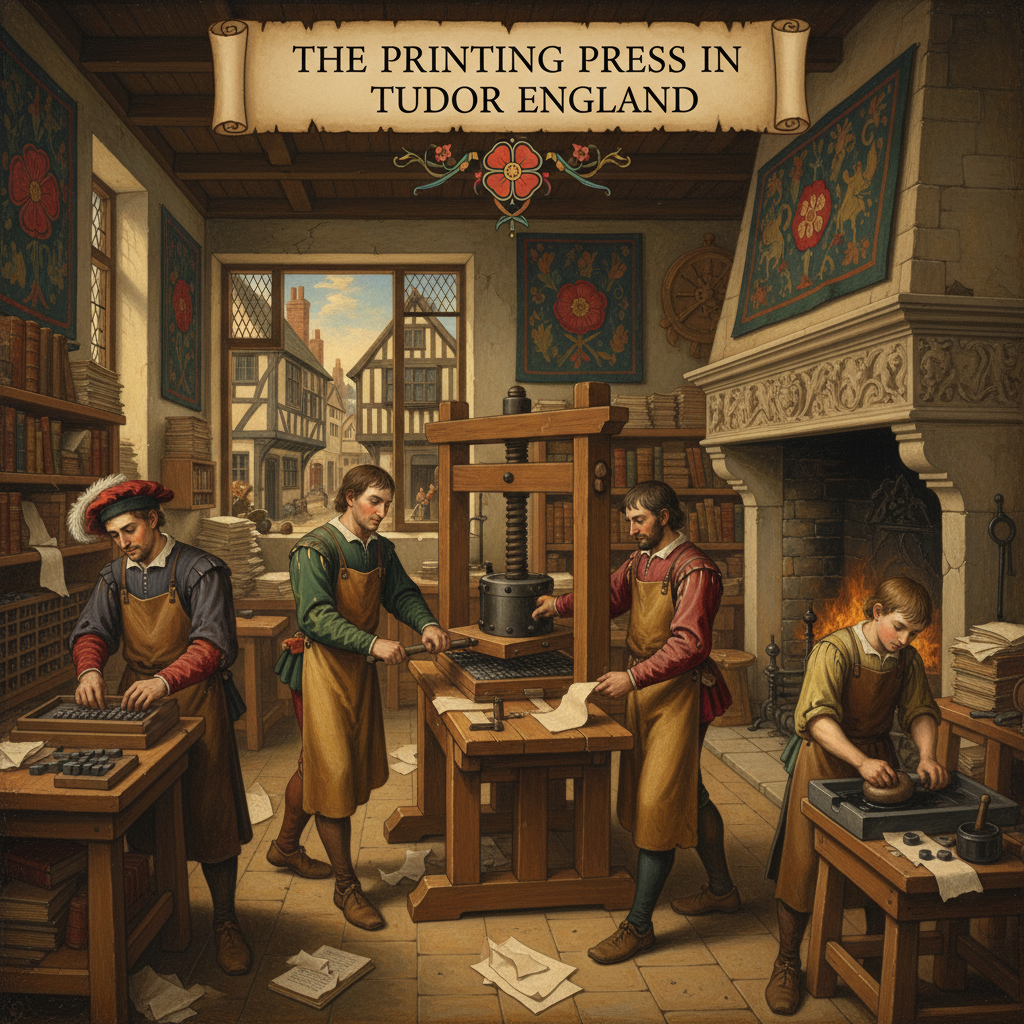
Imagine a world where news travelled at the speed of a horse, books were rare, expensive treasures, and knowledge was largely confined to the elite. This was England before the advent of the printing press. Then, almost overnight, a technological marvel arrived that would irrevocably alter the course of history, shaping everything from religious reform to political power and the very language spoken by millions. The printing press in Tudor England was not merely a machine; it was a catalyst for revolution, a disseminator of ideas, and a powerful, often dangerous, tool in the hands of kings, reformers, and rebels alike. Its story is as dramatic and transformative as any in the Tudor age.
The Arrival and Early Impact: A Quiet Revolution Begins
The printing press, invented by Johannes Gutenberg in Mainz around 1440, made its way to England relatively late compared to continental Europe. It was William Caxton, a merchant, diplomat, and writer, who established the first printing press in England in 1476, initially in Westminster. His first printed book in English was 'The Recuyell of the Historyes of Troye', translated by Caxton himself. This marked a monumental shift from the laborious, error-prone process of hand-copying manuscripts by scribes. Suddenly, books could be produced faster, more cheaply, and in greater numbers, making them accessible to a wider audience than ever before.
Caxton’s early output focused on popular romances, histories, and moral treatises, catering to the burgeoning literate classes. His work, and that of his successors like Wynkyn de Worde, helped to standardise the English language, solidifying spellings and grammar at a time when regional dialects still varied wildly. The demand for printed materials quickly grew, and by the early 16th century, London had become the epicentre of English printing. The initial impact was subtle but profound, laying the groundwork for the intellectual and religious upheavals that would define the Tudor era.
Did You Know?
William Caxton's printing press was located within the precincts of Westminster Abbey, indicating the close relationship between early printing and established institutions, often relying on patronage from the Church or nobility.
From Monasteries to Marketplaces: The Spread of Print
While early printing was often confined to Westminster and then London, its influence radiated outwards. Printers like John Rastell and Richard Pynson expanded the range of printed materials to include legal texts, plays, and even early forms of newspapers, known as 'news ballads' or 'broadsides'. These single-sheet publications, often sensationalist, brought news of battles, executions, and wondrous events to the common people, albeit often with a heavy dose of propaganda.
The printing press also democratised knowledge to an extent previously unimaginable. While literacy rates were still low by modern standards, the availability of printed materials spurred an increase in reading and writing. Merchants, artisans, and even some farmers could now access information that was once the exclusive domain of scholars and the clergy. This spread of information, though initially slow, would prove to be an unstoppable force.
The Reformation and the Printed Word: A Double-Edged Sword
The true power of the printing press became undeniably evident during the English Reformation. Henry VIII's break with Rome, fuelled by theological debates and political ambition, could not have unfolded as it did without the printed word. Both reformers and conservatives used the press as a weapon in the battle for hearts and minds.
"God has opened the press, and it shall never be shut."
— John Foxe, 'Acts and Monuments' (Book of Martyrs)
William Tyndale's English translation of the New Testament, printed on the continent and smuggled into England, challenged the Church's monopoly on scripture and allowed ordinary people to read the Bible in their own tongue. This was a revolutionary act, directly undermining clerical authority. Similarly, Thomas Cranmer's 'Book of Common Prayer', mandated by Edward VI, provided a standardised liturgy in English, further cementing the Reformation's changes through widespread dissemination.
However, the press was a double-edged sword. While it facilitated the spread of reformist ideas, it also allowed for the rapid propagation of dissenting views, seditious pamphlets, and heretical tracts. This led to an intense struggle for control over the press, a battle that would rage throughout the Tudor period and beyond.
Controlling the Narrative: Censorship and Licensing
The Tudor monarchs quickly recognised the immense power of the printing press to shape public opinion and, conversely, to incite rebellion. Consequently, they sought to control it with an iron fist. Early attempts at regulation included royal proclamations against seditious books and the burning of prohibited texts, often alongside their authors.
Under Henry VIII, and particularly during Mary I's reign, censorship was severe. Printers required royal licenses, and the Stationers' Company of London, established by royal charter in 1557, was granted a monopoly over printing. This company was tasked with regulating the industry, suppressing unlicensed presses, and controlling the content of printed materials. Its members acted as both guardians of the trade and agents of the Crown, searching for and seizing forbidden books.
Elizabeth I continued these policies, using the Star Chamber to enforce strict controls. Printers who dared to publish without license or against the Crown's wishes faced imprisonment, fines, or even mutilation. Despite these efforts, clandestine presses continued to operate, producing Puritan tracts, Catholic polemics, and political critiques that challenged the established order. The cat-and-mouse game between printers and authorities was a constant feature of Tudor society.
The Legacy of Print: Shaping Language, Literature, and Law
Beyond religious and political upheaval, the printing press had a profound and lasting impact on English culture and society. It played a crucial role in the development of English literature, making works like Sir Thomas More's 'Utopia' and the poetry of Edmund Spenser and William Shakespeare accessible to a broader readership. The standardisation of the English language, begun by Caxton, continued apace, paving the way for the linguistic richness of the Elizabethan era.
- **Literacy Boost:** The increased availability of books and pamphlets spurred a gradual rise in literacy rates, particularly among the merchant class and gentry.
- **Legal Codification:** Printed law books and statutes made legal knowledge more widely available, contributing to a more uniform application of the law.
- **Scientific Dissemination:** While less prominent than religious texts, early scientific works, almanacs, and medical treatises also found their way into print, slowly spreading new ideas.
- **Propaganda Tool:** Monarchs and their advisors used printed proclamations, sermons, and histories to bolster their legitimacy and influence public opinion.
- **Cultural Exchange:** Printed books facilitated the exchange of ideas with continental Europe, bringing Renaissance humanism and new philosophical currents to England.
The printing press transformed the very fabric of intellectual life. It shifted the locus of knowledge from monastic scriptoria to urban print shops, from the exclusive domain of scholars to the hands of the curious. It fostered a culture of reading and debate, laying the intellectual groundwork for future revolutions in science, philosophy, and politics.
Conclusion: The Unstoppable Tide of Information
The story of the printing press in Tudor England is one of profound transformation. From its tentative beginnings under William Caxton to its central role in the Reformation and its constant struggle against censorship, the press was an engine of change. It empowered individuals, challenged authorities, and fundamentally reshaped how information was created, disseminated, and consumed. While the Tudor monarchs sought to control its output, they ultimately could not stem the tide of ideas it unleashed. The printing press did not just print books; it printed a new future for England, one where the power of the written word would forever alter the landscape of power, knowledge, and society. Its legacy continues to resonate, reminding us of the enduring power of information and the constant tension between control and freedom of expression.
TAGS
Discussion
No comments yet
Be the first to share your thoughts on this article!
Related Articles

Shakespeare's Tudor World: Drama, Power, and Politics
Explore how William Shakespeare’s life and works were profoundly shaped by the political volatility, religious upheaval, and cultural vibrancy of the Tudor era under Queen Elizabeth I.

Tudor Portraiture: Holbein, Power, and the Art of the Image
Explore the revolutionary world of Tudor portraiture, examining how artists like Hans Holbein the Younger and Nicholas Hilliard shaped the public image of monarchs like Henry VIII and Elizabeth I, turning art into essential political propaganda.