Catherine of Aragon: The Enduring Spanish Queen
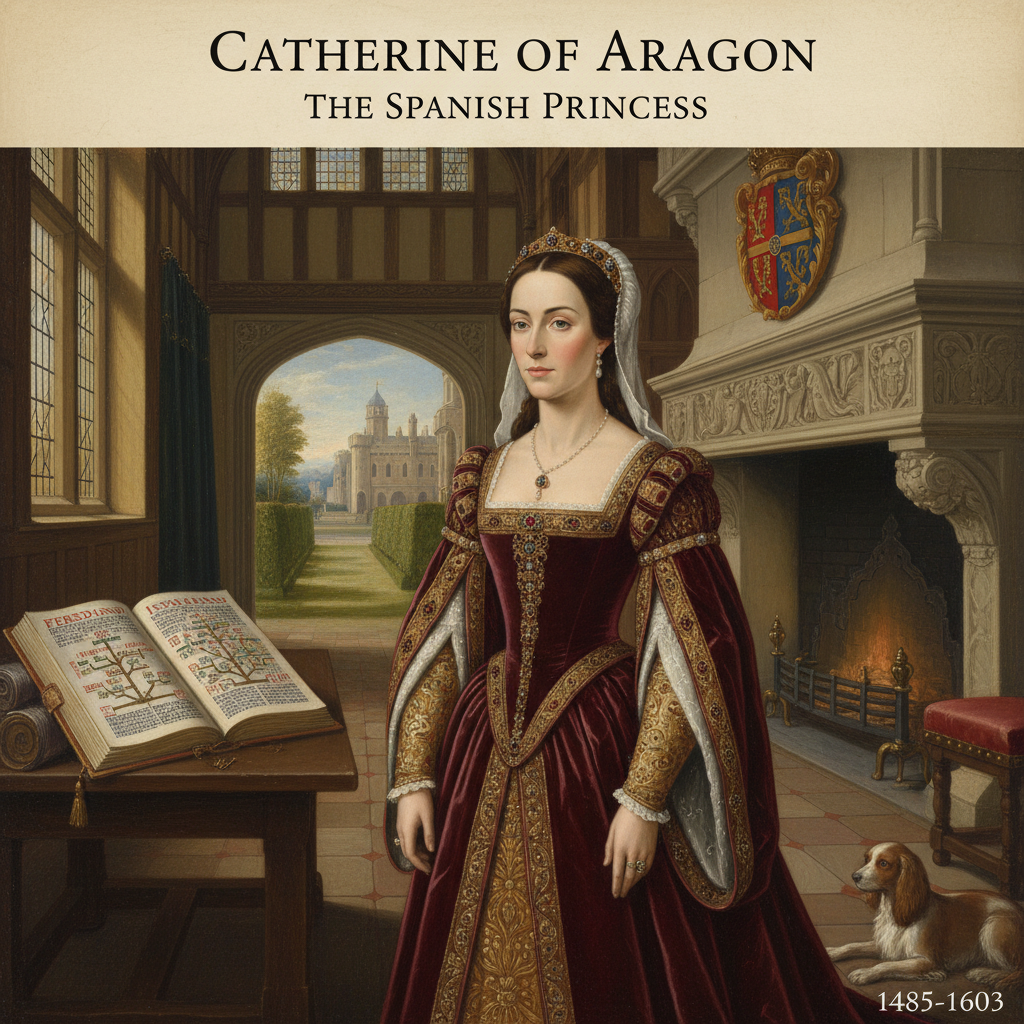
The Spanish Infanta: A Royal Upbringing
Born on December 16, 1485, at the Archbishop's Palace in Alcalá de Henares, Catherine was the youngest surviving child of Ferdinand II of Aragon and Isabella I of Castile. Her childhood was steeped in the fervent Catholicism that defined her parents' reign, a period marked by the Reconquista and the establishment of the Spanish Inquisition. She was educated to be a queen, fluent in Latin, Greek, French, and Spanish, and well-versed in theology, philosophy, and classical literature. Her mother, Isabella, a powerful and intelligent monarch in her own right, served as a formidable role model, instilling in Catherine a strong sense of duty and a deep understanding of statecraft.
"She was a woman of more than ordinary learning, and of a very noble and religious disposition." - George Cavendish, gentleman usher to Cardinal Wolsey
Catherine's early life was not just about academic pursuits; she was also a witness to the unification of Spain and the burgeoning global ambitions of her parents, including the sponsorship of Christopher Columbus's voyages. This upbringing forged a woman of immense strength, capable of holding her own in any court.
A Double Betrothal: England's First Spanish Queen
Catherine's destiny was intertwined with England from a young age. A marriage alliance with the nascent Tudor dynasty was crucial for both Spain and England. In 1501, at the tender age of 15, Catherine arrived in England to marry Arthur, Prince of Wales, the eldest son of King Henry VII. Their marriage was celebrated with great pomp and ceremony, but it was tragically short-lived. Arthur died just five months later, leaving Catherine a widow and her future uncertain. The political implications were enormous; the dowry, a substantial sum, was only half paid, and England was reluctant to lose such a valuable alliance.
To preserve the Anglo-Spanish alliance and the dowry, a new plan emerged: Catherine would marry Arthur's younger brother, the future Henry VIII. This required a papal dispensation, as canon law forbade a man from marrying his brother's widow. Pope Julius II granted the dispensation, citing that the marriage to Arthur was unconsummated. Catherine herself always maintained this, a crucial point that would later become the fulcrum of her life's greatest struggle.
Queen of England: A Reign of Influence and Affection
On June 11, 1509, Catherine married Henry VIII, just weeks after his ascension to the throne. Their early years were marked by genuine affection and mutual respect. Henry, young and charismatic, was deeply enamoured with his intelligent and pious queen. Catherine, in turn, proved to be a capable consort, acting as regent in 1513 while Henry was campaigning in France. During her regency, she famously rallied the English troops to victory against the Scots at the Battle of Flodden, even sending Henry her husband's bloodied coat as proof of the triumph. Her diplomatic skills were also highly valued, as she maintained strong ties with her Spanish family, often mediating between England and Spain.
Did You Know?
Catherine of Aragon was a patron of learning and arts. She commissioned the humanist scholar Juan Luis Vives to write 'The Education of a Christian Woman', a treatise on female education, and was instrumental in promoting women's education in England.
Despite their initial happiness, a shadow loomed over their marriage: the lack of a male heir. Catherine bore Henry six children, but only one, Princess Mary (the future Mary I), survived infancy. This was a devastating blow for both parents and, crucially, for the stability of the Tudor dynasty. Henry became increasingly desperate for a son, fearing a return to the Wars of the Roses if he died without a male successor.
The King's 'Great Matter': A Battle of Wills
By the late 1520s, Henry's desire for a male heir, coupled with his infatuation with Anne Boleyn, led him to question the legitimacy of his marriage to Catherine. He became convinced that his marriage was cursed by God, citing Leviticus 20:21:
TAGS
Discussion
No comments yet
Be the first to share your thoughts on this article!
You May Also Like
Continue exploring Tudor history with these related articles

Catherine of Aragon: The Spanish Princess Who Defined the Tudor Era
Explore the life of Catherine of Aragon, the Spanish Infanta whose marriage to Henry VIII and subsequent refusal to accept an annulment triggered the English Reformation and defined the Tudor era.

The Sickening Truth: Medicine and Health in Tudor England
Dive into the precarious world of Tudor medicine, exploring the reliance on the Four Humours, the terrifying reality of the plague, and the often-dangerous treatments used by physicians, surgeons, and apothecaries in 16th-century England.

The Boleyn Ascent: How a Norfolk Family Conquered the Tudor Court
Explore the astonishing three-generation rise of the Boleyn family, from ambitious London merchants to the pinnacle of power, culminating in Anne Boleyn's controversial queenship and the English Reformation.

The Majesty and Mystery of Tudor Gardens and Landscapes
Explore the sophisticated world of Tudor gardens and landscapes, revealing how these meticulously designed spaces served as powerful symbols of status, utility, and Renaissance order during the reigns of Henry VIII and Elizabeth I.