Catherine Howard: The Tragic 'Rose Without a Thorn'
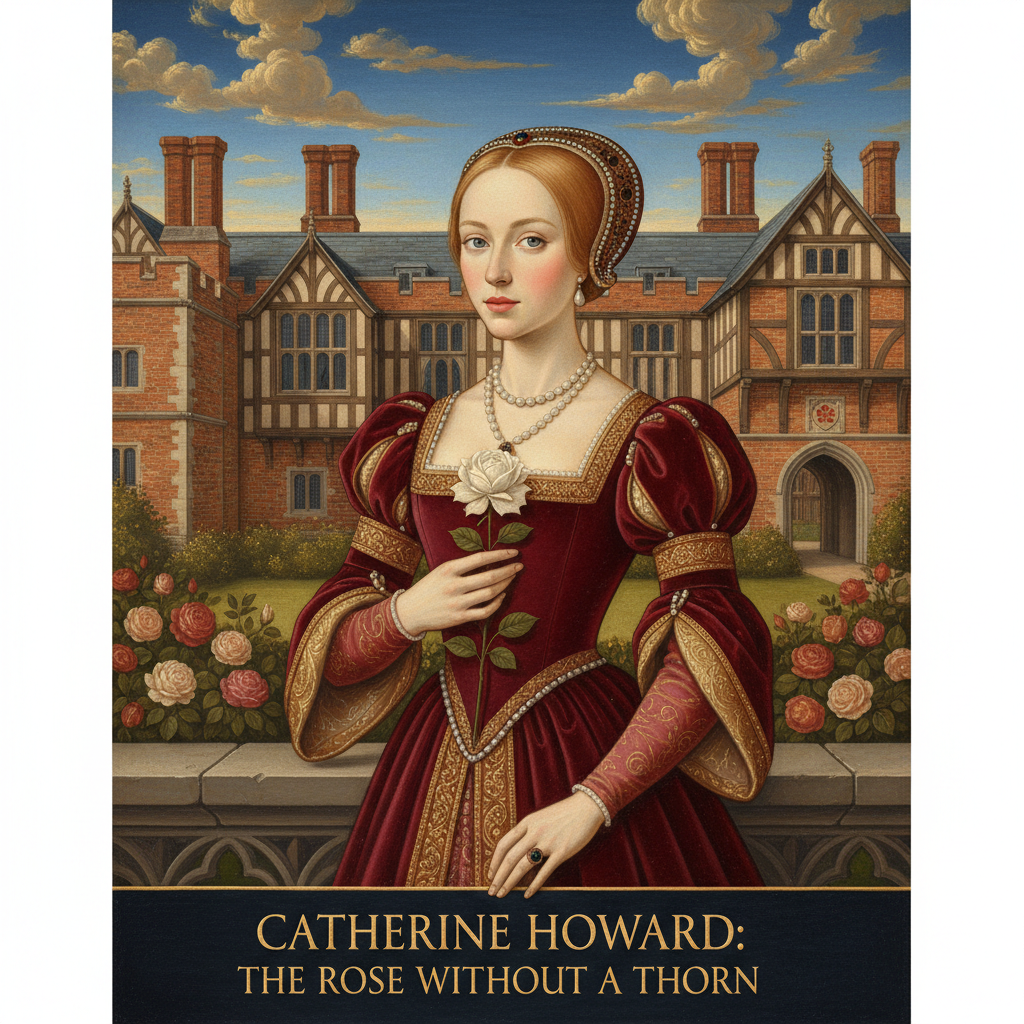
In the tumultuous court of King Henry VIII, where fortunes rose and fell with terrifying speed, few figures encapsulate both the allure and the peril of royal favour quite like Catherine Howard. Heralded as the 'Rose Without a Thorn' upon her marriage to the aging monarch, her brief reign as Queen Consort was a fleeting moment of youthful exuberance that ended in one of the most poignant tragedies of the Tudor era. Her story is not merely one of a young woman caught in the machinations of power, but a stark reminder of the unforgiving nature of a king whose affections were as volatile as his temper.
The Howard Dynasty: A Cradle of Ambition
Catherine Howard was born into one of England's most powerful and ambitious noble families. Her uncle, Thomas Howard, 3rd Duke of Norfolk, was a towering figure at court, and her cousin, Anne Boleyn, had already experienced the dizzying heights and devastating lows of being Henry VIII's queen. This familial connection, while a potential springboard to power, also carried inherent risks, as the Howards were often entangled in the political and religious struggles of the day.
Catherine's early life, however, was far from the refined upbringing one might expect of a future queen. She was sent to live in the household of her step-grandmother, Agnes Tilney, Dowager Duchess of Norfolk, at Lambeth. This was a large, bustling household, often described as rather lax in its supervision of the young women under its care. It was here, amidst a less structured environment than was typical for noble girls, that Catherine, still in her early teens, formed relationships that would later prove to be her undoing.
"She was a young lady of small stature, but of excellent beauty, and of a very amiable countenance..."
Eustace Chapuys, Imperial Ambassador
These early indiscretions, particularly with her music master Henry Manox and later with Francis Dereham, were not uncommon among young courtiers. However, for a woman destined to marry a king who demanded absolute purity and fidelity, they were catastrophic secrets waiting to be unearthed. Her youth and perhaps a lack of proper guidance left her vulnerable to the affections and manipulations of others, sowing the seeds of her future downfall.
A Star Ascends: From Maid of Honour to Queen
Catherine's entry into court came in 1540, when she was appointed a Maid of Honour to Henry VIII's fourth wife, Anne of Cleves. The King, by this point, was a corpulent, ailing man, disillusioned with Anne's appearance and struggling with his own declining health. He quickly became infatuated with the vivacious, youthful Catherine. She was everything Anne was not: lively, beautiful, and seemingly eager to please. Her vivacity and charm offered a stark contrast to the more reserved Anne, and Henry, ever susceptible to a pretty face, was captivated.
The speed of their courtship and marriage was breathtaking. Henry's marriage to Anne of Cleves was annulled in July 1540, and within weeks, on July 28, 1540, Henry VIII married Catherine Howard privately at Oatlands Palace. She was barely 18, and he was 49. The King, rejuvenated by his new, young bride, lavished her with gifts and affection, calling her his "rose without a thorn."
Her time as queen was marked by exuberance. Catherine loved dancing, music, and courtly entertainment, bringing a much-needed lightness to a court that had grown somber under Anne of Cleves and the recent execution of Thomas Cromwell. She was popular, particularly with the younger courtiers, and her presence seemed to lift the King's spirits. For a brief period, it seemed Henry had found the youthful companion he craved, a queen who embodied the ideal of beauty and joy.
Did You Know?
Catherine Howard was the first English queen to have her portrait painted by Hans Holbein the Younger, though no confirmed portrait of her by Holbein survives today. The famous 'Miniature of a Lady' by Holbein is often speculated to be her, but this remains unproven.
The Whispers Begin: Unearthing a Dangerous Past
The honeymoon period, however, was tragically short-lived. The very secrets of her past that had been buried began to resurface. In the autumn of 1541, while Henry and Catherine were on a royal progress, allegations against the Queen began to reach the ears of Archbishop Thomas Cranmer. A former servant in the Dowager Duchess's household, Mary Lascelles, revealed details of Catherine's earlier relationships, particularly with Francis Dereham, claiming they had been pre-contracted to marry – a charge that would invalidate her marriage to the King.
Cranmer, a shrewd politician and survivor of Henry's court, was in a precarious position. He knew the King's reaction to such news would be explosive. He delivered a letter detailing the accusations to Henry during Mass on All Saints' Day, November 1, 1541. The King, initially disbelieving, ordered an investigation.
"The King... was so grieved and perplexed with this advertisement, that he could not refrain tears, lamenting his ill-luck in meeting with such ill-conditioned wives."
Charles Wriothesley, chronicler
The investigation quickly escalated. Francis Dereham, now a gentleman at court, was arrested and confessed to having had a physical relationship with Catherine before her marriage to the King. Crucially, he also implicated Thomas Culpeper, a favourite gentleman of the King's Privy Chamber, in a more recent affair with the Queen during her marriage to Henry. This was the most damning accusation, as it constituted treason.
The Unravelling: Confessions and Condemnations
Under intense pressure and torture, Dereham confessed to his past intimacy with Catherine. He claimed that they had exchanged promises of marriage, which, if true, would have made her subsequent marriage to the King bigamous and therefore invalid. More devastatingly, letters were discovered that implicated Catherine and Thomas Culpeper, indicating a clandestine relationship during her queenship. These letters, though not explicit, suggested a deep affection and secret meetings.
Catherine herself was interrogated. Initially, she denied everything, but faced with mounting evidence and the confessions of others, she eventually admitted to her pre-marital relationships, though she steadfastly denied any pre-contract of marriage with Dereham. She also admitted to allowing Culpeper into her private chambers, though she maintained her innocence regarding adultery during her marriage.
- November 1541: Archbishop Cranmer informs Henry VIII of Catherine's alleged pre-marital indiscretions.
- December 1541: Francis Dereham and Thomas Culpeper are executed for treason.
- January 1542: Parliament passes an Act of Attainder against Catherine Howard, making it treason for a Queen not to disclose her sexual history to the King before marriage, and for anyone to conceal such information.
- February 1542: Catherine is stripped of her title and confined to Syon Abbey.
The King, feeling utterly betrayed and humiliated, ordered the executions of Dereham and Culpeper. They met gruesome deaths at Tyburn in December 1541, their bodies quartered and displayed. The stage was set for Catherine's own tragic end.
The Final Act: Execution at the Tower
On February 10, 1542, Catherine Howard was taken by barge to the Tower of London. She was held in what is now known as the Queen's House, the very place where her cousin Anne Boleyn had spent her final days. The Act of Attainder passed by Parliament removed the need for a trial, condemning her and her lady-in-waiting, Lady Rochford (who had facilitated meetings between Catherine and Culpeper), for treason.
On the morning of February 13, 1542, Catherine Howard walked to the scaffold erected on Tower Hill. Accounts vary, but many suggest she was remarkably calm, though pale. She addressed the assembled crowd, acknowledging her past indiscretions but maintaining her innocence regarding treason against the King. She reportedly asked for mercy for her soul and acknowledged the justice of her sentence, perhaps hoping to spare her family further wrath.
"I die a Queen, but I would rather have died the wife of Culpeper."
Alleged last words of Catherine Howard (though likely apocryphal, it captures the sentiment)
With a single stroke of the axe, Catherine Howard, the 'Rose Without a Thorn,' was executed. She was buried in the Chapel Royal of St Peter ad Vincula within the Tower grounds, alongside Anne Boleyn and other victims of Henry VIII's wrath. She was barely 20 years old.
A Legacy of Youth and Tragedy
Catherine Howard's story remains one of the most poignant and debated episodes in Tudor history. Was she a manipulative schemer, or an innocent victim of circumstance, too young and ill-prepared for the perilous world of court politics? Historians often lean towards the latter, viewing her as a young woman whose past, rather than her present actions, ultimately sealed her fate. Her lack of a strong, guiding hand in her formative years, combined with the ruthless ambition of her family and the King's own volatile nature, created a perfect storm.
Her brief tenure as queen highlights the extreme dangers faced by women in the Tudor court, particularly those who married Henry VIII. The King's insatiable desire for a male heir, coupled with his deep-seated insecurities and fear of betrayal, led to a reign of terror for his wives. Catherine's story serves as a stark reminder of the fragility of life and reputation in a world dominated by absolute power, where a single misstep or a resurrected secret could lead to a swift and brutal end. Her memory endures as a tragic figure, a fleeting bloom crushed by the weight of a crown too heavy for her young shoulders.
TAGS
Discussion
No comments yet
Be the first to share your thoughts on this article!
Related Articles
Thomas Cranmer: Architect of the English Reformation
Explore the life of Thomas Cranmer, Archbishop of Canterbury and chief architect of the English Reformation, from his scholarly rise to his enduring legacy and dramatic martyrdom.
The Howard Family: Power, Peril, and Dukes of Norfolk
Explore the dramatic saga of the Howard family, Dukes of Norfolk, from their rise to power and influence in Tudor England to their perilous proximity to the crown and their enduring legacy.