Thomas Cromwell: Architect of Tudor England's Reformation
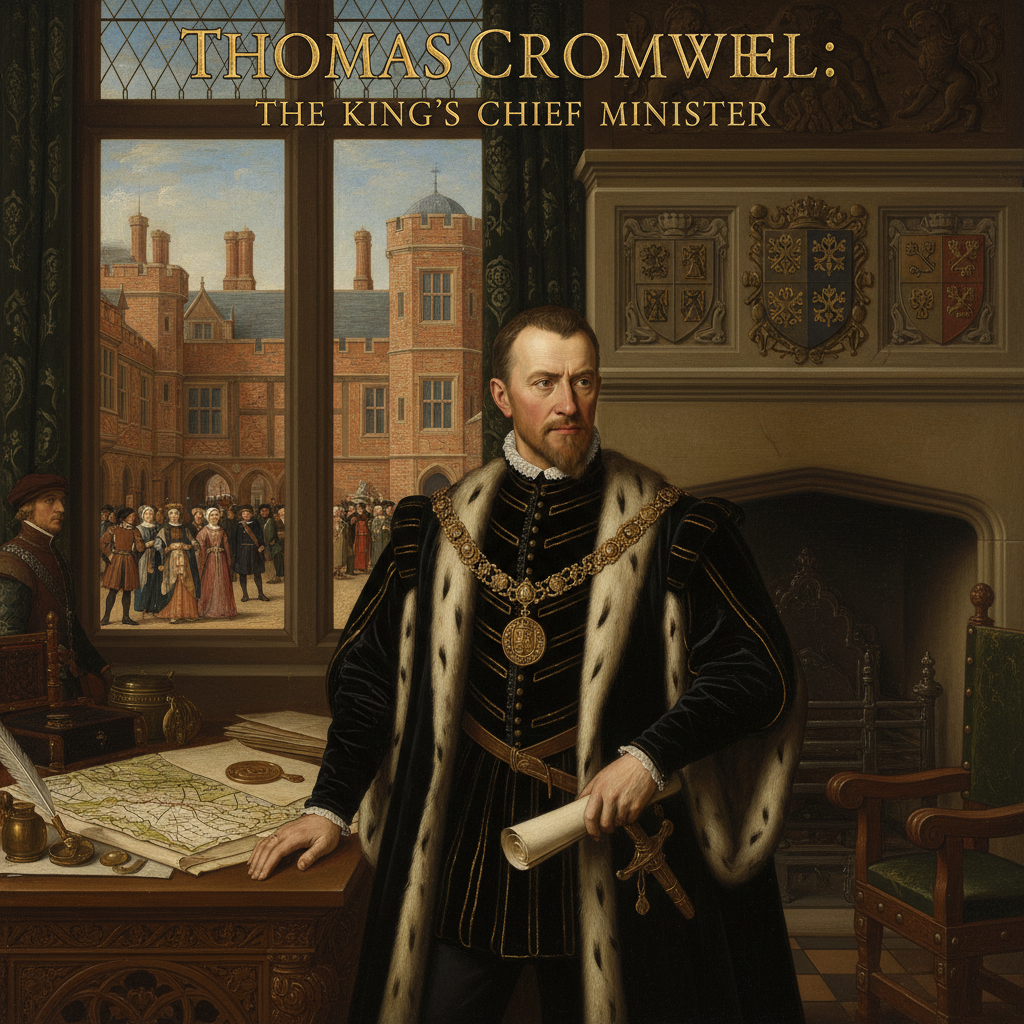
In the tumultuous tapestry of Tudor England, few figures cast as long and complex a shadow as Thomas Cromwell. From humble beginnings as a Putney blacksmith's son, he rose to become King Henry VIII's most trusted and formidable chief minister, a man whose ambition, intellect, and ruthless efficiency irrevocably reshaped the nation. His story is one of meteoric ascent, radical reform, and ultimately, a dramatic fall from grace, leaving an indelible mark on English law, religion, and governance. To understand the seismic shifts of the English Reformation and the consolidation of royal power, one must understand Thomas Cromwell, the man who dared to dismantle centuries of tradition and forge a new path for England.
The Blacksmith's Son: Cromwell's Unlikely Rise
Thomas Cromwell's early life is shrouded in some mystery, a testament to his obscure origins. Born around 1485 in Putney, his father was a brewer and blacksmith, far removed from the aristocratic circles that typically dominated Tudor politics. What is known is that Cromwell left England as a young man, embarking on a continental adventure that would prove formative. He served as a mercenary in the French army in Italy, worked for a Venetian merchant, and spent time in Antwerp, gaining invaluable experience in law, finance, and international relations. This period abroad exposed him to diverse cultures, languages, and the burgeoning ideas of the Renaissance and Reformation, sharpening his mind and practical skills.
Upon his return to England around 1514, Cromwell established himself as a successful merchant, moneylender, and legal adviser. His reputation for shrewdness and competence soon caught the attention of Cardinal Thomas Wolsey, Henry VIII's powerful Lord Chancellor. Wolsey, himself a man of humble origins, recognized Cromwell's talent and brought him into his service. Cromwell became Wolsey's principal secretary and a key administrator, managing the Cardinal's vast household and complex affairs, including the dissolution of some smaller monasteries to fund Wolsey's educational projects. This apprenticeship under England's most powerful minister provided Cromwell with an unparalleled education in statecraft, finance, and the intricate workings of royal power.
"He was a man of very humble birth, but of great natural parts, and of a most profound understanding; and had a wonderful dexterity in business, and a most happy way of extricating himself out of difficulties."
— Gilbert Burnet, "History of the Reformation of the Church of England"
Did You Know?
Thomas Cromwell was fluent in several languages, including Latin, French, and Italian, a rarity for an Englishman of his time, and a skill that greatly aided his diplomatic and administrative work.
The King's Chief Minister: Consolidating Power and Engineering the Reformation
When Cardinal Wolsey fell from grace in 1529, largely due to his failure to secure Henry VIII's annulment from Catherine of Aragon, Cromwell made a perilous but ultimately brilliant move. He defended Wolsey in Parliament, demonstrating loyalty and legal acumen, and then shrewdly positioned himself to gain the King's favour. Henry, desperate for a solution to his 'Great Matter' and increasingly frustrated with the Pope, found in Cromwell a man willing to challenge the established order.
Cromwell quickly rose through the ranks, becoming a Privy Councillor, Master of the Jewels, and eventually, in 1534, Principal Secretary, effectively making him the King's chief minister. His genius lay in his ability to combine legal innovation with political pragmatism. He masterminded the legislative programme that severed England's ties with Rome, transforming the King into the Supreme Head of the Church of England. This was not a sudden act but a series of carefully crafted parliamentary statutes:
- Act in Restraint of Appeals (1533): Declared England an empire, meaning the King was the supreme authority and no appeals could be made to Rome. This paved the way for Henry's marriage to Anne Boleyn.
- Act of Supremacy (1534): Formally declared Henry VIII and his successors as the "Supreme Head of the Church of England."
- Treason Act (1534): Made it treason to deny the King's supremacy, ensuring compliance.
These acts were revolutionary, fundamentally altering the relationship between church and state and laying the foundations for a distinctly English national identity. Cromwell understood that power resided not just in the King's will, but in the laws passed by Parliament, elevating its status and role in governance. He was a master of parliamentary management, skillfully guiding legislation through both Houses.
The Dissolution of the Monasteries: A Financial and Religious Revolution
Perhaps Cromwell's most impactful and controversial policy was the Dissolution of the Monasteries. Initiated in 1536 with the smaller houses and completed by 1540 with the larger ones, this undertaking was driven by a complex mix of motives:
- Financial Gain: The Crown was in dire need of funds, and the vast wealth of the monasteries – lands, jewels, and plate – offered an irresistible solution.
- Religious Reform: Many monasteries were seen as corrupt, outdated, and symbols of papal authority, hindering the King's new religious settlement.
- Political Control: Dissolving these institutions removed potential centers of resistance to the King's supremacy and allowed the Crown to reward loyal gentry with monastic lands.
The dissolution was a monumental administrative task, overseen by Cromwell's meticulous network of commissioners. It reshaped the landscape of England, both physically and socially, leading to the destruction of ancient buildings but also the creation of new landed gentry and the expansion of royal revenue. While it brought immense wealth to the Crown, it also caused significant social upheaval and resistance, most notably the Pilgrimage of Grace in 1536, which Cromwell brutally suppressed.
Cromwell's Downfall: The Price of Ambition
Despite his unparalleled success and the King's favour, Cromwell's position was always precarious. He had made many enemies among the conservative nobility who resented his low birth and radical policies. His close association with Anne Boleyn, whom he helped bring to power and then orchestrate her downfall, further complicated his standing.
His ultimate undoing came with the King's fourth marriage. After Jane Seymour's death, Henry VIII sought a new wife to secure the succession. Cromwell, keen to forge an alliance with the Protestant states of Europe, arranged a marriage between Henry and Anne of Cleves. However, Henry found Anne physically unappealing, famously declaring, "I like her not!" The marriage was a disaster, quickly annulled, and Cromwell's enemies seized their opportunity.
Accused of heresy and treason, Cromwell was arrested on June 10, 1540, at a Privy Council meeting. Despite his years of loyal service and instrumental role in consolidating royal power, he was condemned without trial by an Act of Attainder, a cruel irony given his own use of such legal instruments. On July 28, 1540, Thomas Cromwell was executed on Tower Hill. His execution was notoriously botched, a final, brutal end to a life defined by both brilliance and brutality.
Legacy of a Master Statesman
Thomas Cromwell's legacy is a complex and often debated one. He was undoubtedly a controversial figure, seen by some as a Machiavellian schemer and by others as a visionary statesman. His methods were often ruthless, but his achievements were undeniable.
He transformed England from a medieval kingdom into a more centralized, bureaucratic state, laying the groundwork for future governmental structures. He championed the use of Parliament as the supreme legislative body, a concept that would profoundly influence English constitutional development. His religious reforms, while driven by Henry VIII's personal desires, irrevocably shifted England towards Protestantism, albeit a unique English version.
Cromwell's story is a powerful reminder of the fluidity of power in the Tudor court and the immense risks involved in serving a monarch as capricious as Henry VIII. He rose from obscurity to reshape a nation, demonstrating that in Tudor England, talent and ambition, even without noble birth, could propel a man to the very pinnacle of power, though often at the ultimate cost. His influence continues to resonate, making him one of the most fascinating and pivotal figures in English history, a true architect of modern England.
TAGS
Discussion
No comments yet
Be the first to share your thoughts on this article!
You May Also Like
Continue exploring Tudor history with these related articles

Catherine Parr: The Survivor Queen and Royal Reformer
Catherine Parr, the sixth and final wife of Henry VIII, was a scholar, reformer, and political survivor. Discover how she navigated the treacherous Tudor court, escaped execution, and profoundly influenced the education of the future Elizabeth I and Edward VI.

Greenwich Palace: The Lost Cradle of Tudor Royalty
Discover the lost grandeur of Greenwich Palace (Placentia), the primary residence and crucial birthplace of the Tudor dynasty. This comprehensive article explores how Henry VII established the palace, the spectacular court life under Henry VIII, and its vital role as the birthplace of Henry VIII, Mary I, and Elizabeth I, before its eventual replacement by the Old Royal Naval College.

Edward VI: The Tragic Reign of the Boy King
Edward VI, the only son of Henry VIII and Jane Seymour, ascended the throne at age nine. His brief but transformative reign (1547–1553) saw the radical acceleration of the English Reformation, fundamentally shaping the religious identity of England despite his tragic early death.

Bosworth Field: How Henry VII Won the Crown and Began the Tudor Dynasty
Explore the dramatic Battle of Bosworth Field (1485), where Henry Tudor, the unlikely challenger, defeated Richard III, ending the Wars of the Roses and ushering in the powerful and enduring Tudor dynasty.