Edward VI: The Tragic Reign of the Boy King

When Henry VIII finally secured his long-desired male heir on October 12, 1537, the future of the Tudor dynasty seemed assured. Edward VI, the son of Henry and Jane Seymour, ascended the throne at the tender age of nine, becoming the first English monarch raised entirely within the Protestant faith. His short, six-year reign (1547–1553) was one of the most turbulent and transformative periods in English history, marked by radical religious change, political infighting, and the tragic realization that a child monarch could not truly rule. Edward was no mere figurehead; he was a precocious, deeply pious, and determined young man whose influence, though constrained by his age, irrevocably shaped the religious landscape of England.
The Precarious Accession and the Rise of the Protectors
Edward’s accession in January 1547, following the death of his colossal father, immediately plunged the court into a power struggle. Henry VIII’s will had established a Regency Council, but the reality of governance quickly fell to Edward Seymour, Duke of Somerset and Edward VI’s maternal uncle. Somerset assumed the title of Lord Protector, effectively ruling England in the King’s name. This period, known as the Somerset Protectorate, saw the initial, cautious moves toward Protestant reform.
Somerset, often described as an idealist, sought to govern with a degree of leniency, repealing the notorious Treason Act of 1534 and the Six Articles. However, his foreign policy failures (particularly the costly war against Scotland, culminating in the Battle of Pinkie Cleugh) and his handling of domestic unrest, such as Kett's Rebellion in 1549, eroded his authority. His increasingly autocratic style alienated the rest of the Council, leading to his downfall.
The Education of a Reformer King
Edward VI was perhaps the best-educated monarch ever to sit on the English throne. Taught by prominent humanist scholars like Sir John Cheke and Roger Ascham, Edward was fluent in Latin and Greek, and proficient in French. Crucially, his tutors instilled in him a profound commitment to Reformed theology, viewing the Catholic Mass as idolatry and the Pope as the Antichrist.
His personal journal, a fascinating historical document, reveals a meticulous, observant, and sometimes cold personality. He recorded political events, executions, and even his own illnesses with detached precision. This journal provides invaluable insight into the mind of the boy who was determined to be a true supreme head of the Church.
- Edward VI was the first English monarch to be crowned using the English language.
- He inherited his father’s vast collection of palaces and wealth but also a kingdom deeply divided by religion.
- His personal library contained works by Calvin and other leading European reformers.
- He was known to write detailed theological treatises even before his teenage years.
Did You Know?
Edward VI was a keen astronomer and cartographer. He owned several sophisticated navigational instruments and often discussed celestial mechanics with his tutors, demonstrating a scientific curiosity unusual for the time.
The Radical Shift: The Northumberland Protectorate and Religious Revolution
Somerset’s execution in 1552, following a second attempt to regain power, cleared the way for John Dudley, Earl of Warwick, who soon became the Duke of Northumberland. Northumberland was a far more ruthless and effective politician than Somerset, and his protectorate ushered in the most radical phase of the English Reformation.
Under Northumberland’s guidance, and with Edward’s enthusiastic support, the Church of England moved decisively away from Catholic traditions. The King, now entering his teens, was actively involved in these decisions, often pushing the Council for faster and more thorough reform.
“The King did not only allow of the Reformation, but did also further it, and was grieved that it went on so slowly.” – Gilbert Burnet, History of the Reformation of the Church of England (referencing Edward VI’s zeal)
Key reforms enacted during this period included:
- The Second Act of Uniformity (1552): This made attendance at Anglican services compulsory.
- The Second Book of Common Prayer (1552): This replaced the first, more moderate book. It removed all ambiguity regarding the nature of the Eucharist, explicitly rejecting transubstantiation and replacing the altar with a simple communion table.
- Destruction of Imagery: Systematic campaigns were launched to remove and destroy religious imagery, stained glass, and relics, transforming the appearance of English churches forever.
- Seizure of Chantries: Wealth from chantries and religious guilds was confiscated by the Crown, providing much-needed funds for the depleted royal treasury.
The speed and severity of these changes caused widespread resentment, particularly in the North and West, where Catholic sentiment remained strong. However, Edward VI saw himself as a modern-day Josiah, tasked by God with cleansing the nation of idolatry.
The Succession Crisis and the King’s Last Will
By the beginning of 1553, it was clear that the young King was gravely ill, suffering from what historians now believe was tuberculosis. Faced with his imminent death, Edward VI became obsessed with ensuring the continuation of the Protestant faith. Under the terms of Henry VIII’s will, the Crown would pass to Edward’s half-sister, the staunchly Catholic Mary.
Edward, encouraged by Northumberland, saw Mary’s succession as an existential threat to the Reformation he had championed. He therefore took the extraordinary step of drafting the 'Devise for the Succession,' an attempt to overturn his father’s will and the established laws of succession. This document initially bypassed both Mary and Elizabeth, naming the male heirs of the Grey family (descendants of Henry VIII’s younger sister, Mary Tudor).
Lady Jane Grey: The Nine Days' Queen
When Edward’s health rapidly declined, the Devise was hastily amended to name Lady Jane Grey—Northumberland’s daughter-in-law—as the direct heir. Edward signed the letters patent in June 1553, believing he was saving England from religious darkness.
“He was a prince of so great hope, and such singular expectation, that he seemed to be the very life of the Reformation, and the only pillar of the true religion.” – John Foxe, Acts and Monuments (on the death of Edward VI)
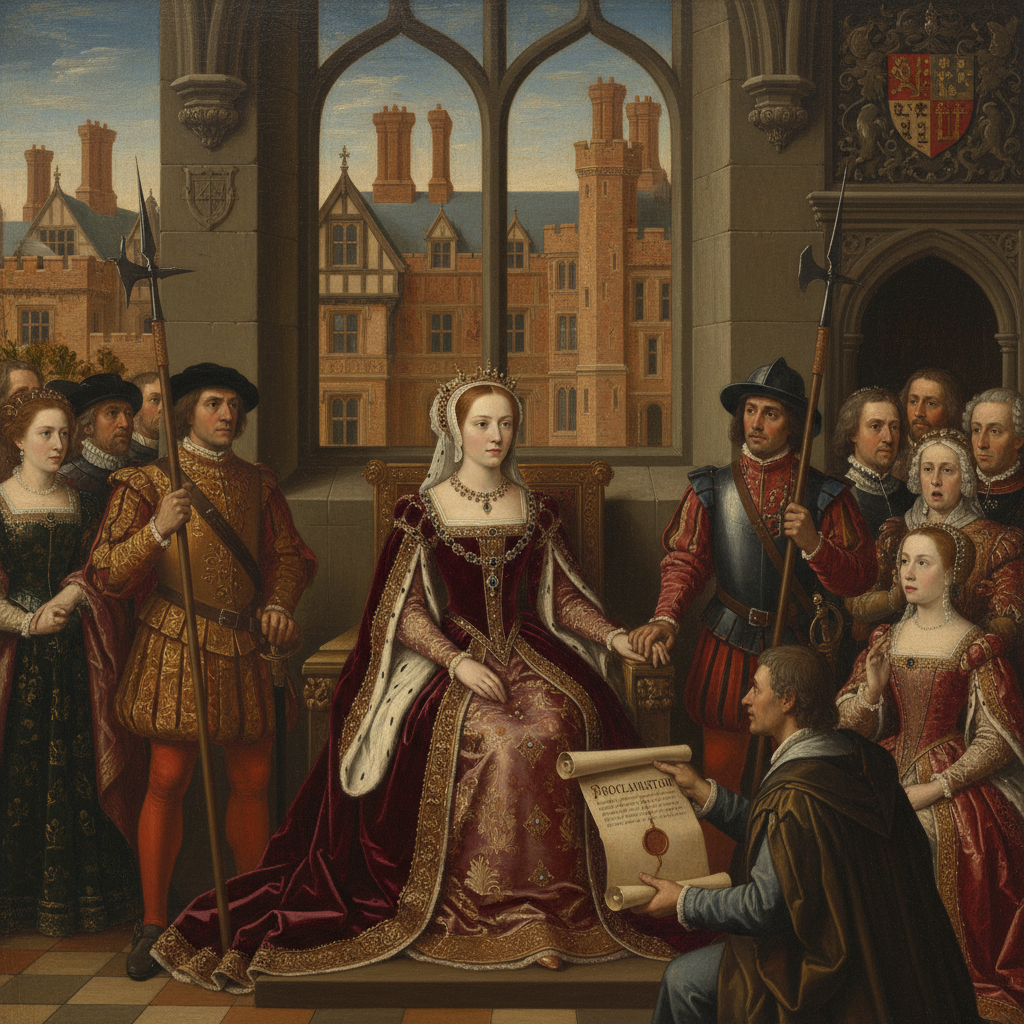
Edward VI died on July 6, 1553, at Greenwich Palace, aged just 15. His death triggered one of the most dramatic succession crises of the Tudor era. Northumberland immediately proclaimed Lady Jane Grey Queen. However, the popular support for the legitimate heir, Mary, proved overwhelming. Jane’s reign lasted only nine days before Mary rode triumphantly into London, marking a temporary, bloody reversal of Edward’s Protestant revolution.
Edward VI’s Enduring Legacy
Despite his brief life, Edward VI’s reign was pivotal. He was the catalyst for the definitive establishment of Protestantism in England. While Mary I attempted to restore Catholicism, the theological and liturgical foundations laid by Edward, particularly the 1552 Book of Common Prayer, provided the blueprint for the Elizabethan Settlement later adopted by his half-sister, Elizabeth I.
Edward VI remains a figure of profound historical 'what if.' Had he lived to adulthood, England would likely have become a far more radically Protestant state, perhaps aligning more closely with the strict Calvinist regimes of continental Europe. His reign demonstrated the immense power wielded by the Crown, even when worn by a child, and the fragility of political stability when the monarch is unable to fully assert their authority. The Boy King, though physically weak, left an indelible mark on the soul of England, ensuring that the Reformation was not merely a political act, but a deeply embedded religious transformation.
Discussion
No comments yet
Be the first to share your thoughts on this article!
You May Also Like
Continue exploring Tudor history with these related articles

Catherine Parr: The Survivor Queen and Royal Reformer
Catherine Parr, the sixth and final wife of Henry VIII, was a scholar, reformer, and political survivor. Discover how she navigated the treacherous Tudor court, escaped execution, and profoundly influenced the education of the future Elizabeth I and Edward VI.

Greenwich Palace: The Lost Cradle of Tudor Royalty
Discover the lost grandeur of Greenwich Palace (Placentia), the primary residence and crucial birthplace of the Tudor dynasty. This comprehensive article explores how Henry VII established the palace, the spectacular court life under Henry VIII, and its vital role as the birthplace of Henry VIII, Mary I, and Elizabeth I, before its eventual replacement by the Old Royal Naval College.
Lady Jane Grey: England's Tragic Nine Days' Queen
Discover the tragic story of Lady Jane Grey, England's 'Nine Days' Queen.' Explore her scholarly life, reluctant ascent to the throne, and ultimate demise in the brutal Tudor power struggles of 1553.

Bosworth Field: How Henry VII Won the Crown and Began the Tudor Dynasty
Explore the dramatic Battle of Bosworth Field (1485), where Henry Tudor, the unlikely challenger, defeated Richard III, ending the Wars of the Roses and ushering in the powerful and enduring Tudor dynasty.