Bosworth Field: How Henry VII Seized the Crown
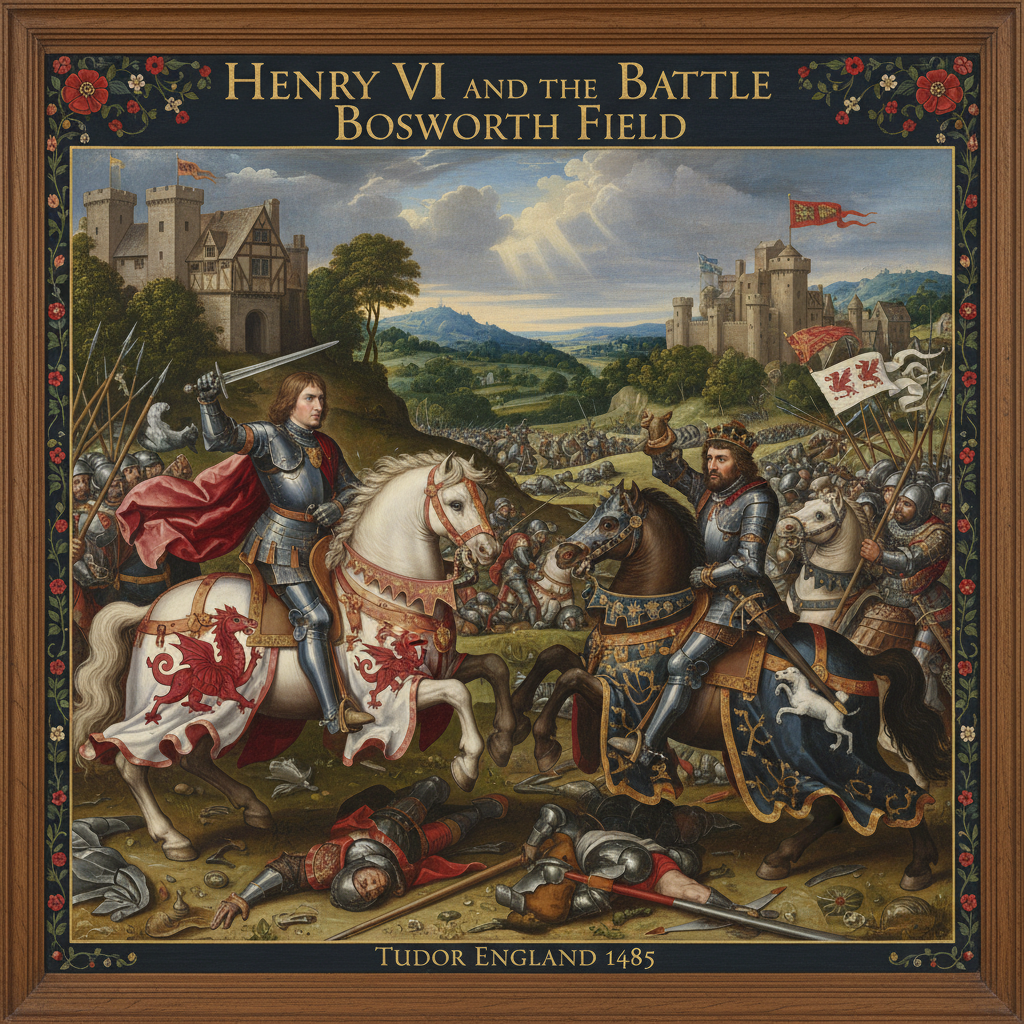
On a sweltering August morning in 1485, a battle unfolded that would forever alter the course of English history. The Battle of Bosworth Field was not merely a clash of armies; it was the dramatic culmination of the Wars of the Roses, a brutal struggle for the English throne that had ravaged the country for decades. It was here that Henry Tudor, a long-shot claimant with a tenuous grasp on legitimacy, faced the formidable Richard III, the last Plantagenet king. The stakes were impossibly high: victory meant a new dynasty, defeat meant oblivion. This single day would see the death of a king, the birth of the Tudor age, and the forging of a new England under the shrewd hand of Henry VII.
The Long Road to Bosworth: Henry Tudor's Exile and Ambition
Henry Tudor's claim to the throne was, by many standards, weak. His mother, Lady Margaret Beaufort, was a descendant of John of Gaunt, Edward III's son, but through an illegitimate line that had later been legitimized on the condition that its descendants could not inherit the crown. Despite this, the Lancastrian cause, decimated by years of conflict, clung to him as their best hope. Henry spent much of his youth in exile in Brittany, a precarious existence constantly under threat from the Yorkist kings, particularly Edward IV and later Richard III, who saw him as a potential rival.
The political landscape in England, however, was volatile. Richard III's accession to the throne in 1483 was controversial, marked by the mysterious disappearance of his nephews, the 'Princes in the Tower'. This act alienated many powerful Yorkist supporters, creating a fertile ground for dissent. Henry, seizing this opportunity, began to gather support, particularly from disaffected nobles like the Stanleys, who, despite their Yorkist leanings, harbored grievances against Richard.
His first invasion attempt in 1483 was a dismal failure, thwarted by storms and lack of coordination. Yet, Henry was persistent. He understood the power of alliances and the necessity of legitimacy. His promise to marry Elizabeth of York, Edward IV's eldest daughter, was a stroke of genius, uniting the warring houses of Lancaster and York and offering a path to peace for a war-weary nation. This strategic move solidified his support base and gave his claim a much-needed boost.
“The usurper (Richard III) was hated by most of the people, for he had murdered his two nephews, the sons of his brother, King Edward, and had taken the crown from them.”
— Polydore Vergil, Anglica Historia
Did You Know?
Henry Tudor's invasion force was surprisingly small, numbering around 2,000 men when he landed at Milford Haven in Wales. He relied heavily on recruiting along his march through Wales and gaining the support of key English magnates to swell his ranks before facing Richard III.
The Gathering Storm: Richard III's Preparations and Henry's March
Richard III, a seasoned warrior and astute military commander, was well aware of Henry's movements. He had spies across the channel and was prepared for an invasion. His army, though perhaps not as large as some accounts suggest, was formidable, comprising experienced soldiers and loyal retainers. Richard's personal banner, featuring a white boar, was a fearsome sight.
Henry landed at Milford Haven in Wales on August 7, 1485. His march through Wales was crucial. He gathered Welsh supporters, leveraging his Welsh ancestry, and slowly built his army. His route was carefully chosen to avoid direct confrontation until he had sufficient strength. As he moved eastward, the crucial question was whether the powerful Stanley family – Lord Thomas Stanley and his brother Sir William Stanley – would declare for him or remain loyal to Richard. The Stanleys, whose lands lay strategically between Henry and Richard, had played a dangerous game of neutrality, their allegiance poised to tip the balance of power.
Richard, meanwhile, mustered his forces near Leicester. He was confident, perhaps overly so, in his military prowess and the loyalty of his commanders. He knew the battle would be decisive, and he was determined to crush the upstart Tudor once and for all. The two armies converged near Market Bosworth, their fates about to be sealed on the fields of Leicestershire.
The Treachery of the Stanleys
The role of the Stanleys is perhaps the most pivotal and controversial aspect of the battle. Lord Thomas Stanley was Henry's stepfather, married to Lady Margaret Beaufort. However, he had also sworn allegiance to Richard III. Richard, wary of the Stanleys, held Lord Stanley's son, Lord Strange, hostage, threatening his execution if the Stanleys betrayed him. This created an agonizing dilemma for Thomas Stanley.
As the battle lines were drawn, the Stanleys positioned their forces between the two main armies, observing the unfolding conflict. Their inaction fueled Richard's frustration and suspicion. Their ultimate decision to intervene on Henry's side, particularly Sir William Stanley's timely charge, proved to be the decisive factor.
The Battle of Bosworth Field: A King's Last Stand
The morning of August 22, 1485, dawned. The terrain at Bosworth was undulating, with a marshy area that Richard shrewdly used to protect his flank. Richard's army, estimated at around 10,000-12,000 men, faced Henry's force of roughly 5,000, though this number would grow with the Stanleys' eventual intervention. Richard, clad in his distinctive armour, rode a magnificent white charger, exuding the confidence of a warrior king.
Henry, lacking military experience, entrusted command of his vanguard to the Earl of Oxford. The battle commenced with an exchange of arrows and artillery. Oxford's disciplined forces held their ground against Richard's initial assault. As the fighting intensified, Richard, observing the Stanleys' continued neutrality and perhaps sensing the tide turning, made a desperate, audacious decision.
He spotted Henry Tudor, who was positioned somewhat apart from the main body of his army, guarded by a relatively small retinue. In a move of incredible courage, or perhaps recklessness, Richard launched a direct charge towards Henry, hoping to end the battle by killing his rival in single combat. He cut down several of Henry's bodyguards, including Sir William Brandon, Henry's standard-bearer. For a moment, it seemed as though Richard might succeed.
It was at this critical juncture that Sir William Stanley, seeing Richard's desperate charge and Henry's peril, finally committed his forces. His cavalry, estimated at around 3,000 men, swept down upon Richard's flank, shattering his personal guard and turning the tide of the battle decisively. Richard, surrounded and outnumbered, fought valiantly to the last. He reportedly refused to flee, declaring he would die a king. He was cut down, his crown reportedly falling into a hawthorn bush nearby.
“Thus was the noble king Richard, most valiantly fighting in the midst of his enemies, slain and brought to his death.”
— John Rous, Historia Regum Angliae
The Dawn of a New Era: Henry VII and the Tudor Dynasty
With Richard III's death, the battle was over. Henry Tudor was proclaimed King Henry VII on Crown Hill, near the battlefield, reportedly crowned with Richard's battered crown, retrieved from the hawthorn bush. His victory was absolute, but his challenges were just beginning. He had to consolidate his power, unite a fractured kingdom, and establish the legitimacy of his new dynasty.
Henry VII proved to be a shrewd and effective monarch. He married Elizabeth of York, as promised, symbolically uniting the red rose of Lancaster and the white rose of York into the Tudor Rose. He worked tirelessly to restore royal authority, replenish the treasury, and establish a stable government. His reign, though not without its challenges from Yorkist pretenders, laid the foundations for the powerful and influential Tudor dynasty that would rule England for over a century, producing monarchs like Henry VIII and Elizabeth I.
The Battle of Bosworth Field remains a pivotal moment in English history. It marked the end of the Plantagenet line, the conclusion of the Wars of the Roses, and the beginning of the Tudor era. It was a day of high drama, courage, betrayal, and ultimately, the triumph of a man who, against all odds, seized a crown and reshaped a nation. The legacy of Bosworth reminds us that even in the most chaotic of times, a single battle can change everything, ushering in a new age and forging the destiny of a kingdom.
TAGS
Discussion
No comments yet
Be the first to share your thoughts on this article!
You May Also Like
Continue exploring Tudor history with these related articles

Catherine Parr: The Survivor Queen and Royal Reformer
Catherine Parr, the sixth and final wife of Henry VIII, was a scholar, reformer, and political survivor. Discover how she navigated the treacherous Tudor court, escaped execution, and profoundly influenced the education of the future Elizabeth I and Edward VI.

Greenwich Palace: The Lost Cradle of Tudor Royalty
Discover the lost grandeur of Greenwich Palace (Placentia), the primary residence and crucial birthplace of the Tudor dynasty. This comprehensive article explores how Henry VII established the palace, the spectacular court life under Henry VIII, and its vital role as the birthplace of Henry VIII, Mary I, and Elizabeth I, before its eventual replacement by the Old Royal Naval College.

Edward VI: The Tragic Reign of the Boy King
Edward VI, the only son of Henry VIII and Jane Seymour, ascended the throne at age nine. His brief but transformative reign (1547–1553) saw the radical acceleration of the English Reformation, fundamentally shaping the religious identity of England despite his tragic early death.

Bosworth Field: How Henry VII Won the Crown and Began the Tudor Dynasty
Explore the dramatic Battle of Bosworth Field (1485), where Henry Tudor, the unlikely challenger, defeated Richard III, ending the Wars of the Roses and ushering in the powerful and enduring Tudor dynasty.