Tudor Education: Learning, Literacy, and Life in 16th-Century England
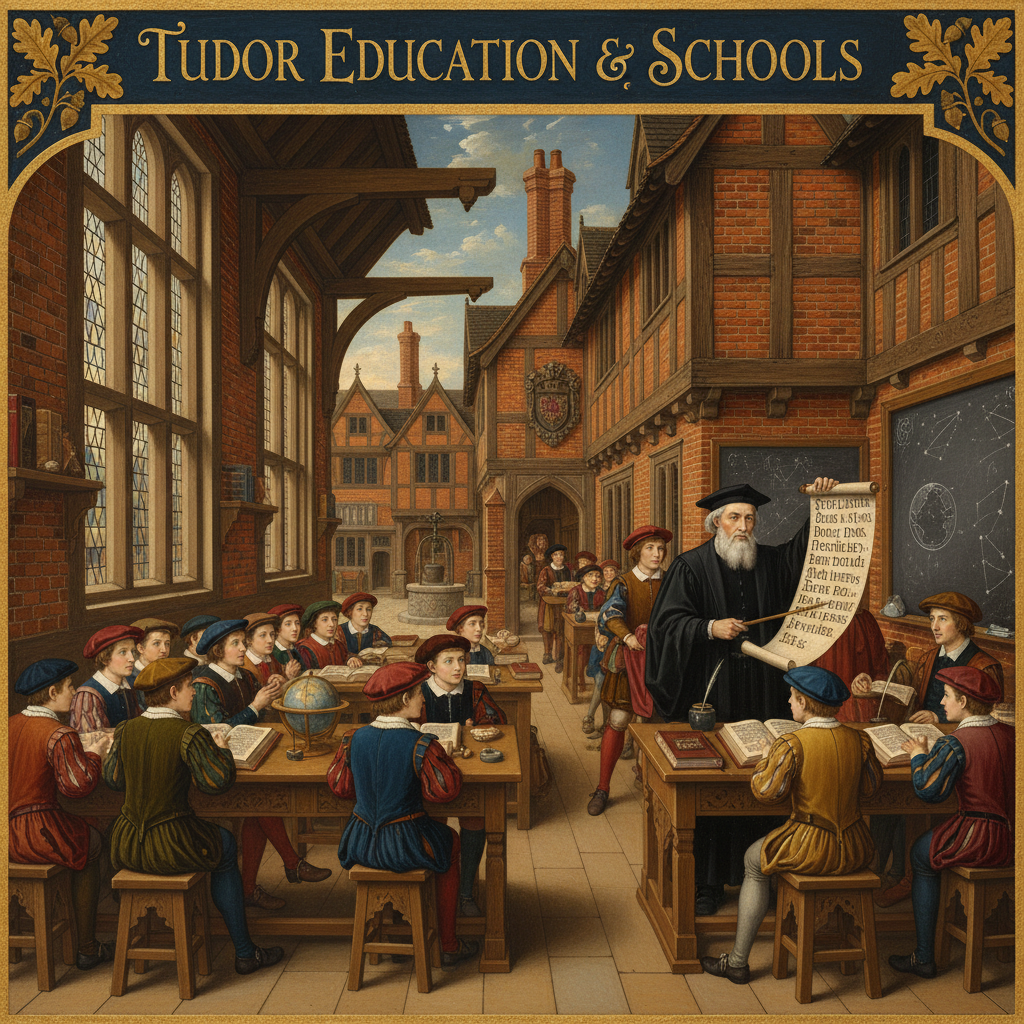
Imagine a world without universal schooling, where education was a privilege, not a right, and where the curriculum was dictated by faith, social standing, and the pressing needs of a rapidly changing nation. This was the reality of Tudor England, a period of profound transformation that saw significant shifts in how knowledge was acquired, disseminated, and valued. From the hallowed halls of grammar schools to the humble lessons taught at home, education during the Tudor era laid the groundwork for future intellectual and social developments, shaping the minds that would define an age.
The Foundations of Tudor Learning: Home, Church, and Petty Schools
For the vast majority of Tudor children, formal schooling, as we understand it today, was a distant dream. Education began, and often ended, within the confines of the home. Mothers, and sometimes fathers, were responsible for teaching basic literacy and numeracy. Girls, especially, were trained in household management, needlework, and religious instruction, preparing them for their roles as wives and mothers. Boys, particularly those from farming or artisan families, would learn their father's trade from a young age, an apprenticeship being their primary form of 'education'.
The Church also played a pivotal role. Before the Reformation, monasteries and chantries often provided some form of schooling, particularly for boys destined for the clergy. The dissolution of the monasteries by Henry VIII, however, initially created a vacuum, though many of their educational functions were eventually absorbed or replaced by new institutions. Parish priests often offered basic instruction, teaching the Lord's Prayer, the Ten Commandments, and the Creed in English, as well as rudimentary reading from hornbooks – wooden paddles with a printed sheet protected by a thin layer of horn.
Did You Know?
Hornbooks were not books at all, but a single page, often containing the alphabet, vowels, and the Lord's Prayer, mounted on a wooden paddle and covered with a transparent sheet of horn for protection. They were the primary tool for teaching basic literacy to young children.
For those with a little more means, 'petty schools' (also known as 'ABC schools') offered the next step. These were small, often privately run schools, typically taught by a local clergyman or a literate woman, where children learned to read and write in English. The curriculum was simple: the alphabet, syllables, basic words, and religious texts. Petty schools were crucial for bridging the gap between home learning and more advanced institutions.
"Children are not to be taught to read English, till they can perfectly say the Catechism, and have learned to write a little, and then they are to be taught to read the Bible." - From a 16th-century educational treatise, highlighting the religious focus of early literacy.
Grammar Schools: The Path to University and Public Service
The true engine of advanced Tudor education was the grammar school. These institutions, often founded by wealthy benefactors, guilds, or the Crown, were designed to teach Latin grammar, the lingua franca of scholarship, law, and international diplomacy. Boys, typically from the age of seven or eight, would enter grammar school and spend several years immersed in Latin, learning to read, write, and speak it fluently. Greek was also increasingly introduced, especially after the Renaissance brought a renewed interest in classical texts.
The curriculum was rigorous and demanding. Students would study classical authors such as Cicero, Virgil, Ovid, and Horace. Rhetoric, logic, and arithmetic were also taught, preparing students for university or careers in the church, law, or government. Discipline was strict, often involving corporal punishment, reflecting the prevailing belief that a child's will needed to be broken to instil obedience and diligence.
Notable Grammar Schools and Their Impact
- St Paul's School: Founded in 1509 by John Colet, Dean of St Paul's Cathedral, this school was revolutionary for its time. It was open to boys of all social classes (though fees were charged), focused on Christian humanism, and had a lay headmaster, departing from the traditional clerical leadership.
- King Edward VI Grammar Schools: Many grammar schools were re-founded or established during the reign of Edward VI, often using assets from dissolved chantries. These schools played a vital role in expanding educational opportunities, albeit still primarily for boys from the gentry and merchant classes.
- Winchester College and Eton College: These older, prestigious public schools continued to thrive, offering a high-quality, classical education to the sons of the elite, preparing them for leadership roles.
The Reformation had a profound impact on grammar schools. While it led to the closure of some church-affiliated schools, it also spurred the foundation of new ones, often with a Protestant emphasis. The curriculum shifted slightly, with more attention paid to biblical studies and Protestant theology, but the core focus on classical languages remained.
University Life: Oxford and Cambridge
For the brightest and most ambitious grammar school graduates, the ultimate destination was one of England's two ancient universities: Oxford or Cambridge. These institutions were not merely places of academic study but also centres of religious and political thought. Students, often as young as 14 or 15, would matriculate and live in colleges, which functioned as self-contained communities with their own chapels, libraries, and teaching staff.
The university curriculum was primarily based on the 'seven liberal arts': the 'Trivium' (grammar, rhetoric, and logic) and the 'Quadrivium' (arithmetic, geometry, astronomy, and music). Theology was the highest faculty, followed by law and medicine. Debates, lectures, and disputations were central to the learning process. Life at university was disciplined, with strict rules governing behaviour, dress, and attendance at religious services.
The Reformation deeply affected the universities. They became battlegrounds for theological debate, and their curricula were reformed to align with Protestant doctrines. Figures like Thomas Cranmer and Hugh Latimer were prominent at Cambridge, while Oxford saw its own share of religious upheaval. Despite the changes, Oxford and Cambridge remained the pinnacle of Tudor intellectual life, producing the statesmen, clergy, and scholars who would shape the nation.
Education for Girls and the Lower Classes
While the grammar schools and universities were almost exclusively for boys, it would be a mistake to assume that girls received no education. As mentioned, home education was vital. For wealthy girls, tutors might be employed to teach them languages (French, Italian, and sometimes Latin), music, dancing, and needlework – skills deemed essential for attracting a suitable husband and managing a large household. Queens like Elizabeth I, who was fluent in multiple languages and highly educated, served as powerful examples of female intellectual capability, though her education was exceptional.
Convents, prior to their dissolution, had also provided education for girls, particularly those from noble families. After the Reformation, some private schools for girls emerged, though they were far less common than those for boys. The emphasis for girls' education remained on domestic skills and moral instruction, rather than academic pursuits.
For the vast majority of the lower classes, formal education was simply out of reach. Children were expected to contribute to the family economy from a young age. Their education was practical: learning a trade, farming techniques, or domestic duties. Literacy rates, while difficult to precisely measure, were certainly much lower among the poor, though the spread of printed materials, especially religious texts, did contribute to a gradual increase in basic reading skills across society.
The Legacy of Tudor Education
Tudor education, though vastly different from modern schooling, laid crucial foundations for England's future. It fostered a literate elite capable of administering a complex state, engaging with the intellectual currents of the Renaissance, and defending the nation's religious identity. The emphasis on classical languages and rhetoric instilled a love of learning and a command of expression that defined the age of Shakespeare and beyond.
While access was unequal and the methods often harsh, the Tudor period saw a significant expansion of educational opportunities compared to earlier centuries, particularly through the proliferation of grammar schools. This era cemented the idea that education, especially for boys, was vital for national prosperity and individual advancement. The schools and universities of Tudor England were not just places of learning; they were crucibles where the future of a nation was forged, shaping the minds that would navigate the complexities of a new world.
TAGS
Discussion
No comments yet
Be the first to share your thoughts on this article!
You May Also Like
Continue exploring Tudor history with these related articles

Justice and Terror: Unmasking Tudor Crime and Punishment
Explore the brutal reality of Tudor justice, from petty theft leading to the gallows to the horrific spectacle of high treason executions. Discover how the Tudors used public terror and a vast network of JPs to maintain absolute control over a volatile society.

Behind the Scenes: Life of Tudor Servants and Household Staff
Explore the complex, hierarchical world of Tudor servants and household staff. From the politically powerful Grooms of the Stool to the tireless workers Below Stairs, discover how this vast, unseen workforce maintained the machinery of the royal court and noble houses, revealing a vital layer of Tudor society.

Sovereigns of the Sea: Tudor Ships and the Age of Exploration
Explore how Tudor ships, from Henry VIII's massive carracks to Elizabeth I's streamlined galleons, fueled England's transformation into a naval power, driving exploration, privateering, and the defeat of the Spanish Armada.

The Root of the Realm: Tudor Agriculture and Farming
Explore the vital role of Tudor agriculture, from the medieval open-field system to the disruptive rise of enclosure, and discover how farming shaped the economy and society of 16th-century England.