Tudor Agriculture: The Backbone of a Golden Age
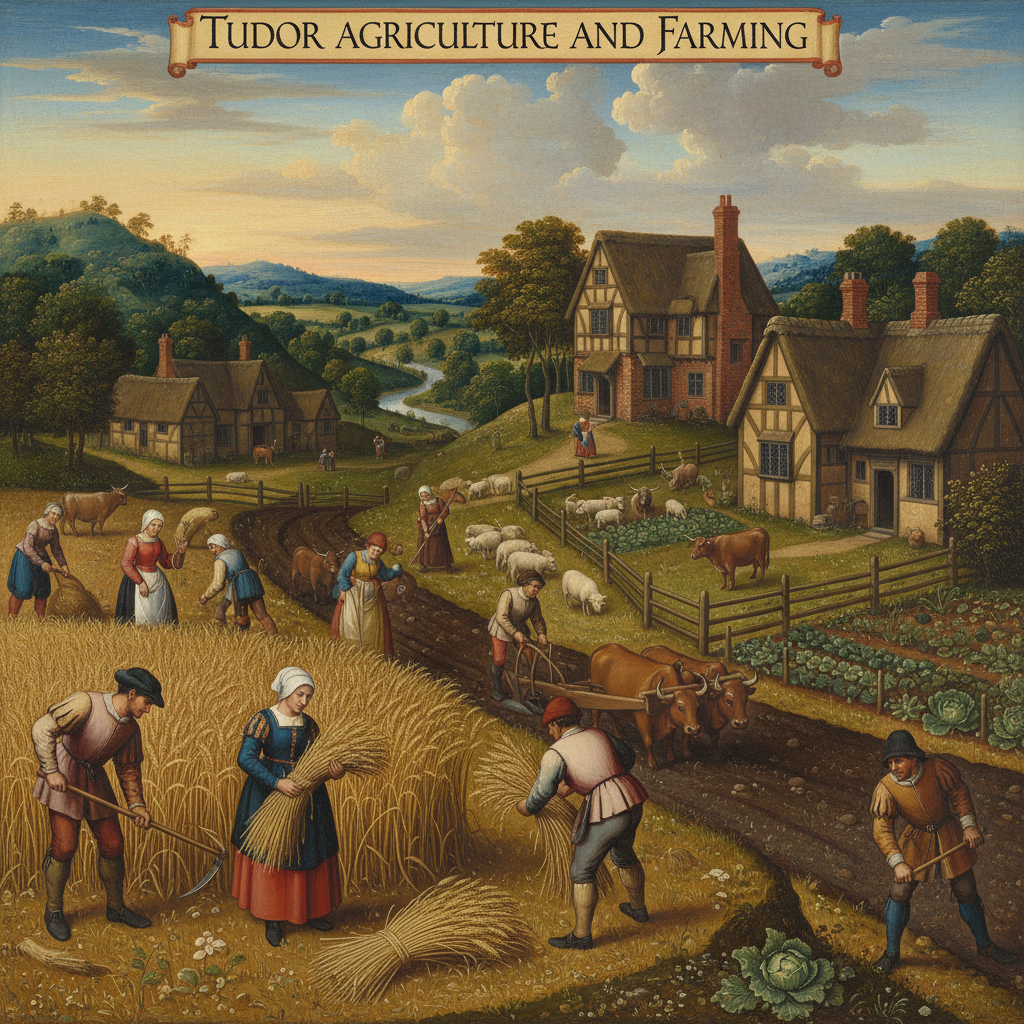
Imagine a world where the rhythm of life was dictated by the sun, the seasons, and the soil. This was the reality for the vast majority of people living in Tudor England. Far from the opulent courts and political intrigues we often associate with the Tudors, the true engine of the kingdom was its agricultural landscape, a complex tapestry of fields, livestock, and human endeavour. It was a time of significant change, with ancient traditions clashing with new ideas, all shaping the very fabric of English society and laying the groundwork for future prosperity.
The Land and Its People: A Rural Dominance
Tudor England was overwhelmingly an agrarian society. Estimates suggest that over 90% of the population lived and worked in rural areas, directly or indirectly dependent on farming for their livelihoods. The landscape itself was a patchwork of open fields, enclosed lands, common pastures, and dense woodlands, each playing a vital role in the agricultural economy. The land was not just a source of food; it was the primary form of wealth, status, and power.
For centuries, the open-field system had dominated much of England. Under this system, large fields were divided into narrow strips, often unfenced, and cultivated by different tenants. This communal approach, while ensuring a degree of fairness and shared risk, also limited innovation and efficiency. However, the Tudor era saw the accelerating trend of enclosure, where common lands and open fields were fenced off into private holdings. This controversial practice, driven by a desire for greater agricultural efficiency, particularly for sheep farming, led to significant social upheaval.
"The poor man's common is taken away, and the rich man's sheep are put in his place."
– Robert Crowley, 1550
While enclosures often displaced tenant farmers and sparked rebellions like Kett's Rebellion in 1549, they also paved the way for more intensive and specialised farming practices. Landowners could now experiment with crop rotation, selective breeding, and improved drainage, leading to increased yields.
Crops, Livestock, and the Daily Bread
The staple of the Tudor diet, and thus the primary focus of agriculture, was grain. Wheat, barley, rye, and oats were cultivated across the country. Wheat was the preferred grain for bread among the wealthier classes, while barley and rye were more common for the poor, often mixed to make 'maslin' bread. Oats were essential for animal feed and also used for porridge and ale.
Beyond grains, a variety of other crops were grown. Peas and beans were crucial protein sources, while root vegetables like turnips and carrots were becoming more common, though less so than in later centuries. Hemp and flax were cultivated for textiles, providing raw materials for clothing and ropes. Orchards supplied apples, pears, and plums, often used for cider and preserves.
- **Wheat:** For fine bread, often grown in the south-east.
- **Barley:** Used for brewing ale (a daily drink) and coarser bread.
- **Rye:** Hardier grain, common in poorer soils, used for dark bread.
- **Oats:** Animal feed, porridge, and some brewing.
- **Peas & Beans:** Vital protein, often grown as field crops.
- **Flax & Hemp:** Industrial crops for linen, ropes, and canvas.
Livestock played an equally critical role. Sheep were arguably the most economically significant animal, their wool being England's primary export and the foundation of its immense wealth. The demand for wool was so high that it often drove the enclosure movement. Cattle provided meat, milk, cheese, and butter, as well as oxen for ploughing. Pigs were ubiquitous, kept by nearly every household, providing meat that could be easily preserved. Chickens, geese, and ducks supplied eggs and poultry.
The Farmer's Year: A Cycle of Toil
Life for a Tudor farmer was a relentless cycle dictated by the seasons. Spring saw ploughing and sowing, followed by constant weeding and tending of crops. Summer was dominated by the crucial harvest, a period of intense labour where every able-bodied person, including women and children, was pressed into service. Autumn brought threshing, milling, and the slaughter of livestock for winter provisions. Winter was a time for repairs, spinning, weaving, and preparing for the next year's planting.
Did You Know?
The average Tudor ploughing team consisted of eight oxen, a significant investment for any farmer. The ploughman would guide the plough, while an ox-goader walked alongside, urging the animals forward.
Tools were rudimentary but effective. The heavy plough, often pulled by oxen, turned the soil. Harrows smoothed the ground. Scythes and sickles were used for harvesting, and flails for threshing grain. Innovation was slow but steady, with improvements in plough design and the gradual adoption of more efficient crop rotation methods, such as the Norfolk four-course system beginning to emerge towards the end of the Tudor period, though not widespread until later.
Markets, Trade, and the Price of Provisions
Agricultural produce was not just for subsistence; it fuelled a vibrant internal economy. Local markets were the lifeblood of every town and village, where farmers sold their surplus goods and bought necessities they couldn't produce themselves. Larger regional markets and annual fairs facilitated trade over greater distances. London, as the burgeoning capital, was a massive consumer, drawing provisions from a wide radius, transported by river and rudimentary roads.
The price of food was a constant concern for the Tudor government. Poor harvests could lead to scarcity, price spikes, and widespread famine, triggering social unrest. The Crown often intervened, issuing proclamations to prevent hoarding, control grain exports, and regulate market practices. The Statute of Artificers (1563) even attempted to regulate wages and labour, reflecting the government's deep involvement in the agricultural economy.
"There is no better way to increase the wealth of the kingdom than to cherish and maintain the husbandman, for he is the foundation of all."
– Sir Thomas Smith, De Republica Anglorum, 1583
The wool trade, as mentioned, was paramount. English wool was highly prized across Europe, particularly in the Low Countries, and its export generated enormous wealth for the Crown and landowners. This economic engine, however, also created tensions, as the drive for more pasture land often conflicted with the need for arable land to feed the growing population.
Social Structures and the Farming Hierarchy
The agricultural landscape mirrored the rigid social hierarchy of Tudor England. At the top were the great landowners – the nobility and gentry – who owned vast estates and leased land to tenants. Below them were the yeomen, a class of independent farmers who owned or leased substantial holdings and were often quite prosperous. They formed a crucial backbone of rural society, often serving as local officials and contributing to the stability of the realm.
The majority, however, were husbandmen, small tenant farmers who worked modest plots of land, often struggling to make ends meet. Below them were cottagers, who owned little or no land, relying on common rights, gardening, and wage labour for survival. At the very bottom were the landless labourers, who hired themselves out for daily wages, often living in precarious poverty.
Women played an indispensable role in Tudor agriculture. While men typically handled the heavy field work, women were responsible for dairy production, poultry, gardening, brewing, spinning, and often assisted with lighter field tasks, especially during harvest. Their labour was vital for the household economy and the overall success of the farm.
Legacy of Tudor Farming
Tudor agriculture, despite its challenges and inequalities, was a period of fundamental transformation. The shift from communal open fields to enclosed, private holdings, the increasing specialisation of farming, and the growing commercialisation of agricultural produce all laid crucial groundwork for the agricultural revolutions of later centuries. The Tudors presided over a period where the land was not just a source of survival, but a dynamic economic engine that shaped society, politics, and the very identity of England.
Understanding Tudor farming is to understand the daily lives, struggles, and triumphs of the vast majority of people who lived under the formidable Tudor monarchs. It reminds us that behind the grand narratives of kings and queens, it was the tireless work in the fields that truly sustained the realm and allowed its golden age to flourish. The echoes of these agricultural practices can still be seen in the landscape and traditions of rural England today, a testament to the enduring legacy of the Tudor farmer.
TAGS
Discussion
No comments yet
Be the first to share your thoughts on this article!
You May Also Like
Continue exploring Tudor history with these related articles

Justice and Terror: Unmasking Tudor Crime and Punishment
Explore the brutal reality of Tudor justice, from petty theft leading to the gallows to the horrific spectacle of high treason executions. Discover how the Tudors used public terror and a vast network of JPs to maintain absolute control over a volatile society.

Behind the Scenes: Life of Tudor Servants and Household Staff
Explore the complex, hierarchical world of Tudor servants and household staff. From the politically powerful Grooms of the Stool to the tireless workers Below Stairs, discover how this vast, unseen workforce maintained the machinery of the royal court and noble houses, revealing a vital layer of Tudor society.

Sovereigns of the Sea: Tudor Ships and the Age of Exploration
Explore how Tudor ships, from Henry VIII's massive carracks to Elizabeth I's streamlined galleons, fueled England's transformation into a naval power, driving exploration, privateering, and the defeat of the Spanish Armada.

The Root of the Realm: Tudor Agriculture and Farming
Explore the vital role of Tudor agriculture, from the medieval open-field system to the disruptive rise of enclosure, and discover how farming shaped the economy and society of 16th-century England.